The 5 Best Survival Knives of 2026
 By Ian Freng-Meeteer
Updated November 16, 2026
A good survival knife is the one tool almost every preparedness guide agrees on. This list covers the main types: a hard-use folder I carry, two full-tang fixed blades, a bushcraft classic that costs about $20, and a pocket knife for everyday carry. Knives are sharp and can be dangerous, so these are recommendations for responsible adults. Check your local carry laws before you buy.
Quick answer: Our top pick is the Off-Grid Stinger (best Overall). The hard-use assisted folder I carry. Best for: everyday carry, hiking.
- Best Full-Tang Tanto: Cold Steel Kobun
- Best Value: Mora Companion HD
- Best Budget: S&W 10.6″ Fixed
- Best for EDC: Kershaw Blur
Best survival knives compared
| Product | Type | Blade | Best for | Buy |
|---|---|---|---|---|
 Off-Grid Stinger
Best Overall |
Assisted folder | Spear point | Everyday carry, hiking | Check price on Amazon |
 Cold Steel Kobun
Best Full-Tang Tanto |
Fixed blade, full tang | 5.5" tanto, AUS-8A | Pack and vehicle kits | Check price on Amazon |
 Mora Companion HD
Best Value |
Fixed blade | 4.1" carbon, Scandi | Bushcraft, every kit | Check price on Amazon |
 S&W 10.6" Fixed
Best Budget |
Fixed blade | 5.2" tanto | Budget backup | Check price on Amazon |
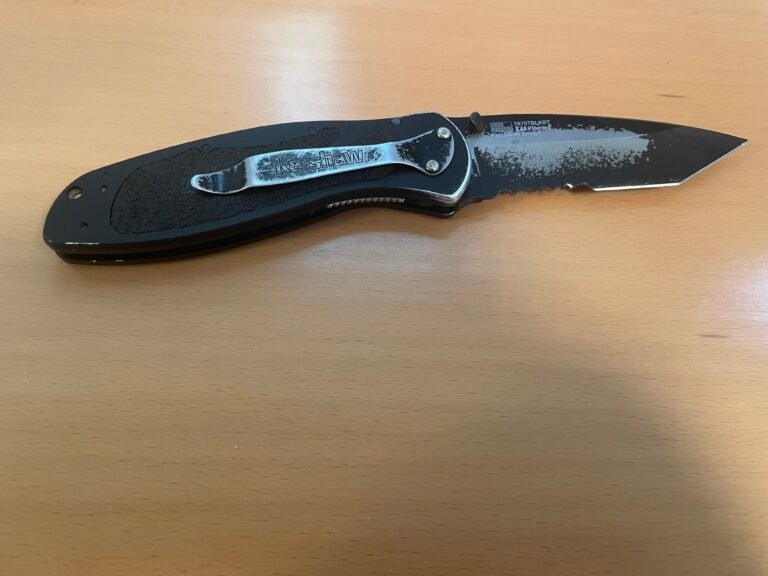 Kershaw Blur
Best for EDC |
Assisted folder | 3.4" tanto, part serrated | Everyday carry | Check price on Amazon |
We may earn a commission when you buy through links on this page, at no extra cost to you. As an Amazon Associate we earn from qualifying purchases.
Quick picks
- Best overall: Off-Grid Knives Rapid Fire Stinger, the one I carry. A hard-use assisted folder that has never let me down.
- Best full-tang tanto: Cold Steel Kobun: a 5.5″ serrated tanto fixed blade.
- Best value fixed blade: Morakniv Companion Heavy Duty: the bushcraft standard for about $20.
- Best budget big blade: Smith & Wesson 10.6″ Fixed Blade: a lot of knife for the money.
- Best for everyday carry: Kershaw Blur Tanto: an assisted-opening pocket knife made in the USA.
How to choose the best survival knife
Fixed blades have no pivot or lock to fail, so they’re the better choice for hard work: batoning firewood, carving, building shelter and food prep. Folders are easier and more legal to carry every day, which means you’re more likely to actually have one on you when something happens. A good setup is a fixed blade in your pack or bug-out bag and a folder in your pocket.
- Full tang (the steel runs through the whole handle) is the strongest construction for a fixed blade.
- Carbon steel sharpens easily and takes a keen edge but rusts if neglected. Stainless is lower-maintenance.
- Blade length: 4–5 inches covers almost every real survival task. Longer blades get unwieldy for fine work.
1. Off-Grid Knives Rapid Fire Stinger: best overall
Off-Grid Knives Rapid Fire Stinger
The hard-use assisted folder I carry.
- Type Assisted folder
- Blade Spear point
- Best for Everyday carry, hiking
What we like
- Fast one-hand assisted opening
- Strong spear-point tip
- Light enough for daily carry
What we don't
- Folder, not for batoning
- Assisted knives are restricted in some areas
This is the knife I’ve personally carried and field-tested, and it’s never let me down. It’s built for hard use: the assisted opening gets the blade out fast with one hand, and the spear-point profile keeps the tip strong for everyday cutting chores at camp and on the trail. It’s light enough to carry daily without noticing it.
Where it falls short: it’s still a folder. For batoning wood or heavy prying, pair it with a fixed blade. Also check your local laws, since some areas restrict assisted-opening knives.
2. Cold Steel Kobun: best full-tang tanto
Cold Steel Kobun Serrated Tanto Fixed Blade
A slim 5.5" AUS-8A tanto with partial serrations.
- Type Fixed blade, full tang
- Blade 5.5" tanto, AUS-8A
- Best for Pack and vehicle kits
What we like
- Reinforced tanto tip
- AUS-8A resists rust
- Serrations for rope and webbing
What we don't
- Not ideal for carving
The Kobun is a slim 5.5″ American-tanto fixed blade in Japanese AUS-8A stainless steel, with a partially serrated edge for cutting rope and webbing. The tanto tip is reinforced for strength, and AUS-8A is easy to sharpen in the field and resists rust well. It’s a solid fixed blade for a pack or vehicle kit.
Where it falls short: the slim profile and tanto tip are better for straight cutting than for carving or bushcraft.
3. Morakniv Companion Heavy Duty: best value fixed blade
Morakniv Companion Heavy Duty Carbon Fixed Blade
The bushcraft standard for about $20.
- Type Fixed blade
- Blade 4.1" carbon, Scandi
- Best for Bushcraft, every kit
What we like
- Very affordable
- Scandi grind is easy to sharpen
- Great for carving and ferro rods
What we don't
- Not full tang
- Carbon steel needs oiling
Few pieces of outdoor gear are as widely recommended as a Mora. The Heavy Duty version uses a thicker carbon-steel blade than the standard Companion, with a Scandi grind that’s easy to sharpen on a stone and excellent for carving, feather sticks and striking a ferro rod. At around $20, it’s the knife to put in every kit.
Where it falls short: it isn’t a full tang, so don’t use it for prying. The carbon steel needs to be dried and oiled to prevent rust.
4. Smith & Wesson 10.6″ Fixed Blade: best budget big blade
Smith & Wesson 10.6in Fixed Blade Tanto
A lot of fixed blade for well under $50.
- Type Fixed blade
- Blade 5.2" tanto
- Best for Budget backup
What we like
- Low price
- Grippy TPE handle
- Includes sheath
What we don't
- Average edge retention
A 5.2″ high-carbon stainless tanto blade with a grippy TPE handle and sheath, for well under $50. It’s a lot of knife for the price: a reasonable choice for a vehicle kit, a backup bug-out bag, or someone who wants a larger fixed blade without spending much.
Where it falls short: edge retention and fit and finish reflect the price, so expect to sharpen it more often than the premium knives.
5. Kershaw Blur Tanto: best for everyday carry

Kershaw Blur Tanto Pocket Knife
An assisted-opening EDC tanto, made in the USA.
- Type Assisted folder
- Blade 3.4" tanto, part serrated
- Best for Everyday carry
What we like
- Quick one-hand opening
- Grippy handle inserts
- Made in USA
What we don't
- Pocket-size blade only
I’ve used the Blur for both everyday carry and backcountry day trips, and it’s a blade I trust. Kershaw’s assisted opening makes it quick to deploy one-handed, the tanto blade is partially serrated for rope and cord, and the grippy handle inserts hold well even when wet. It’s made in the USA.
Where it falls short: at 3.4″ it’s a pocket knife, not a camp knife. Pair it with a fixed blade for heavier work.
Keeping a survival knife ready
- Carry a small sharpener (a pocket stone or ceramic rod) in the same kit as the knife.
- Dry and lightly oil carbon steel after use, especially before storing it in a bag for months.
- Don’t pry with the tip. Snapped tips are the most common way survival knives fail.
What makes a good survival knife?
- Strong construction: full tang for fixed blades, a solid lock for folders.
- Useful blade length: about 4–5 inches covers nearly every real task.
- Steel you can maintain: carbon steel sharpens easily; stainless resists rust.
- A secure, comfortable grip that works when wet or cold.
- A good sheath or clip so the knife is actually on you when you need it.
Pair this with our guides to the best survival multi-tools and the best survival axes and hatchets.
Survival knife FAQ
What makes a good survival knife?
A strong blade around 4–5 inches, full-tang construction for fixed blades (or a solid lock on a folder), steel you can sharpen in the field, a grippy handle and a secure sheath.
Are folding knives reliable for survival?
A quality folder with a strong lock is reliable for everyday cutting, and you’re more likely to carry it daily. For hard work like batoning wood, a fixed-blade survival knife is the safer choice.
What is the best bushcraft knife?
The Morakniv Companion Heavy Duty is the best value: a thick carbon blade with a Scandi grind that’s easy to sharpen and excellent for carving and striking a ferro rod.
How do I maintain a high-carbon or D2 steel knife?
Keep it dry, wipe a thin coat of oil on the blade after use, store it out of a damp sheath, and touch up the edge regularly. A gray patina on carbon steel is normal and helps resist rust.
Do serrated blades have a place in survival kits?
Partial serrations help cut rope, webbing and seatbelts, but they’re harder to sharpen and worse for carving. A plain edge is more versatile; partial serration is a fair compromise on a folder.
What is the best all-around survival knife?
For most people, a 4–5 inch fixed blade (like the Mora Companion HD or Cold Steel Kobun) paired with a reliable everyday folder covers everything.
Final thoughts on the best survival knives
Everyone should own at least one good survival knife, and know how to use it safely. My everyday folder is the Off-Grid Stinger; for hard camp work, pair a folder with a fixed blade like the Mora. Keep it sharp, keep it dry, and check your local carry laws.