The Best Snowshoes for Hiking and Backcountry Trails (2026)
 By Ian Freng
Updated November 23, 2026
When I head out after a big storm, I’ve found that the depth of fresh, unpacked snow decides whether you need snowshoes: once you sink past your ankles with every step, you burn energy fast and cover very little ground. The best snowshoes fix that by spreading your weight so you stay near the top of the snow. But the right pair depends on your terrain. Flat trails, rolling hills and steep mountains each call for different bindings, heel lifts and crampons. This guide covers five snowshoes for each kind of terrain, including a pair for kids, and shows you how to size them with each maker’s own weight chart.
Quick answer: Our top pick is the MSR Evo Trail (best for beginners and rolling trails). A durable plastic-deck snowshoe with steel traction rails and an easy stretch binding, made for flat and rolling trails.
- Best for mountains and steep terrain: MSR Lightning Ascent
- Best for backcountry comfort: Tubbs Flex VRT
- Best lightweight trail snowshoe: Atlas Helium Trail
- Best for kids: Tubbs Snowball (kids)
Best snowshoes compared
| Product | Sizes | Load range | Heel lift | Terrain | Buy |
|---|---|---|---|---|---|
 MSR Evo Trail
Best for beginners and rolling trails |
22 in | Up to 180 lb (250 lb with tails) | None listed | Flat to rolling | $126.89 at Amazon |
 MSR Lightning Ascent
Best for mountains and steep terrain |
22, 25, 30 in | Up to 180 / 120-220 / 150-280 lb | Ergo Televator | Mountain, backcountry | $291.89 at Amazon |
 Tubbs Flex VRT
Best for backcountry comfort |
25, 29 in (men's) | 120-200 lb / over 190 lb | 19° ActiveLift | Backcountry, steep | $279.95 at Amazon |
 Atlas Helium Trail
Best lightweight trail snowshoe |
23, 26, 30 in | 80-160 / 150-220 / 200-270+ lb | 12° | Trail walking, rolling | $104.96 at Amazon |
 Tubbs Snowball (kids)
Best for kids |
16 in (this link) | Under 50 lb | None listed | Flat, beginner | $39.44 at Amazon |
Amazon price as of Nov 23, 2026 5:15 pm GMT+0000. Prices and availability are accurate as of the date/time indicated and are subject to change.
We may earn a commission when you buy through links on this page, at no extra cost to you. As an Amazon Associate we earn from qualifying purchases.
Quick picks
- Best for beginners and rolling trails: MSR Evo Trail: a tough, simple snowshoe for packed trails and rolling terrain.
- Best for mountains and steep terrain: MSR Lightning Ascent: MSR’s lightest, most technical snowshoe for steep, icy climbs.
- Best for backcountry comfort: Tubbs Flex VRT: a flexing deck and a BOA binding for big days in steep terrain.
- Best lightweight trail snowshoe: Atlas Helium Trail: a light composite snowshoe with a heel lift for rolling trails.
- Best for kids: Tubbs Snowball (kids): a simple, easy-on snowshoe for kids ages 4 to 8.
How I picked these
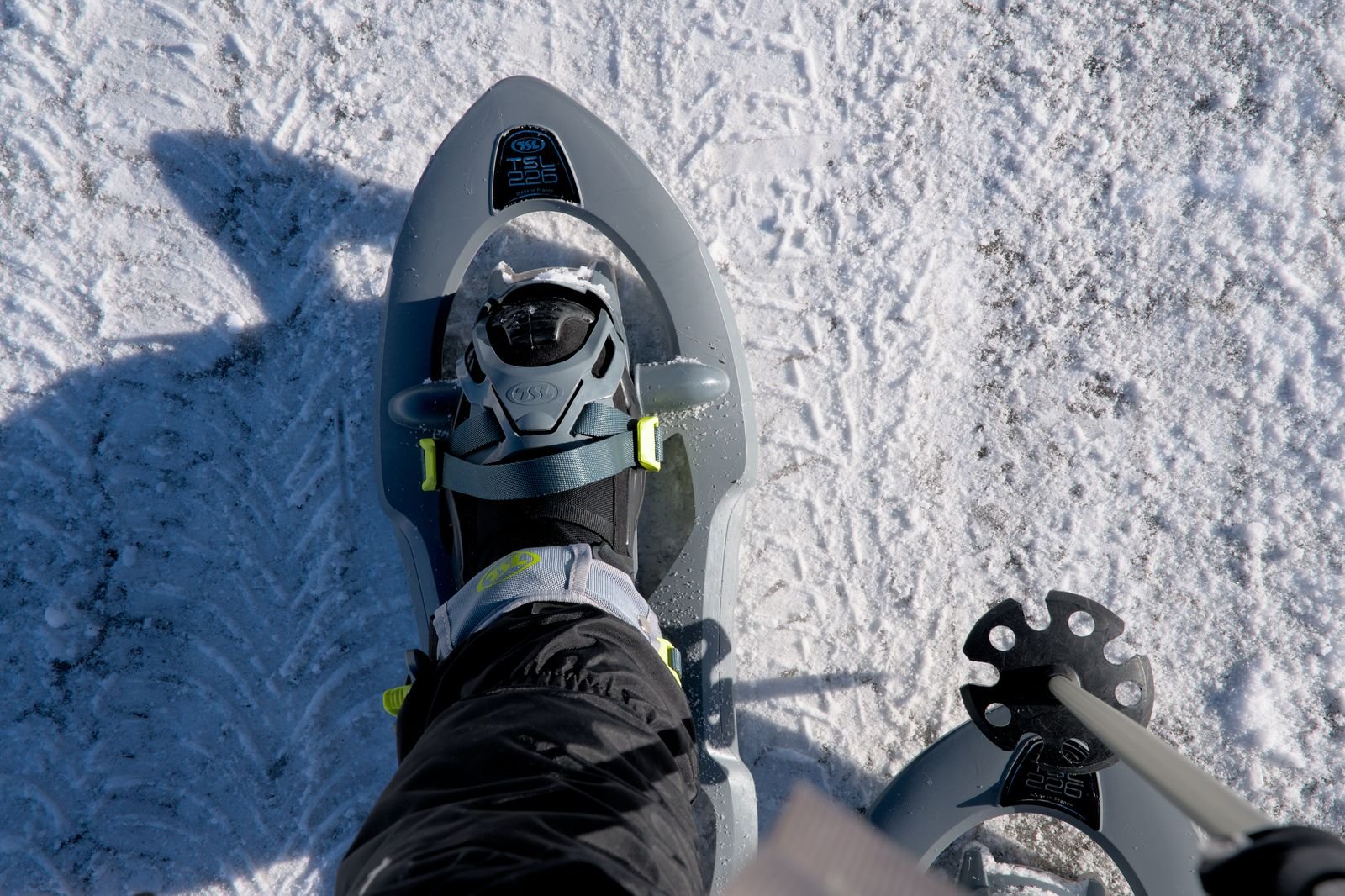
I’ve been hiking for 20 years and backpacking for 16, and winter trails are some of my favorite miles. Snowshoes open up the same trails in winter, but only if you pick the right type for the terrain. I compared these snowshoes on the things that change how they feel on the trail: the maker’s load range for each size, the binding, whether there’s a heel lift, the crampons and traction, and the terrain each one is built for.
Specs and weight ranges come from MSR, Tubbs and Atlas product pages and the Amazon listings. Load ranges are the makers’ own and include your body weight plus everything you carry: clothes, boots and a loaded pack. Makers base them on typical snow, and Tubbs notes that deep, light powder may call for a larger size.
1. MSR Evo Trail: best for beginners and rolling trails
MSR Evo Trail Snowshoes, 22 Inch Pair
A durable plastic-deck snowshoe with steel traction rails and an easy stretch binding, made for flat and rolling trails.
- Sizes 22 in
- Load range Up to 180 lb (250 lb with tails)
- Heel lift None listed
- Terrain Flat to rolling
What we like
- Molded deck with steel traction rails and brake bars
- Steel crampons for packed snow and crust
- Paraglide stretch-mesh binding fits a wide range of footwear
- Optional tails add flotation (up to 250 lb)
- Simple and very durable
What we don't
- No heel lift for steep climbs
- One 22-inch size: heavier users need the tails
- Plastic deck can be noisy on hard snow
Amazon price as of Nov 23, 2026 5:15 pm GMT+0000. Prices and availability are accurate as of the date/time indicated and are subject to change.
The MSR Evo Trail is the snowshoe to start with. Its one-piece molded deck has steel traction rails and brake bars built in, plus steel crampons underfoot, so it grips packed trails, crust and gentle hills. MSR lists the 22-inch Evo Trail at 3 lb 10 oz per pair, with a load range of up to 180 lb. That includes your body, clothes and pack.
The current version uses MSR’s Paraglide binding, a stretch-mesh strap that fits nearly any winter boot or hiking shoe and is quick to get in and out of with gloves on. If you weigh more with gear, or you’re heading into deeper snow, MSR’s optional modular tails clip on and raise the load range to up to 250 lb. MSR’s spec table doesn’t list a heel lift on this model, which keeps it simple and best for flat and rolling terrain.
Where it falls short: with no heel lift, steep climbs are tiring on the calves, and the single 22-inch size means bigger hikers need to buy the tails for deep snow. The hard deck can also be loud on icy trails.
2. MSR Lightning Ascent: best for mountains and steep terrain
MSR Lightning Ascent Backcountry & Mountaineering Snowshoes with Paragon Bindings, 22 Inch Pair
A light aluminum-frame snowshoe with 360-degree traction, steel crampons and heel lifts for steep mountain terrain.
- Sizes 22, 25, 30 in
- Load range Up to 180 / 120-220 / 150-280 lb
- Heel lift Ergo Televator
- Terrain Mountain, backcountry
What we like
- 360-degree traction frame grips on side-hills
- Steel DTX crampons
- Ergo Televator heel lifts for climbing
- Paragon binding fits hiking, mountaineering and snowboard boots
- Three sizes plus a women's version
What we don't
- More than most flat-trail hikers need
- Thin frame gives less flotation than a wide deck in deep powder without tails
Amazon price as of Nov 23, 2026 5:15 pm GMT+0000. Prices and availability are accurate as of the date/time indicated and are subject to change.
The MSR Lightning Ascent is built for steep, icy mountain terrain. Its 7075-T6 aluminum frame is shaped into a 360-degree traction edge, so the whole perimeter bites when you traverse a slope. Steel DTX crampons sit under the foot, and Ergo Televator heel lifts flip up to put your feet closer to level on long climbs.
MSR makes it in three sizes. The 22-inch pair weighs 4 lb 2 oz and is rated up to 180 lb, the 25-inch is rated 120 to 220 lb, and the 30-inch is rated 150 to 280 lb. Optional 5-inch tails raise each range. The Paragon binding uses a stretch-mesh strap and a steel footplate, and MSR says it fits a wide range of footwear, from hiking boots to mountaineering and snowboard boots. This link is the 22-inch unisex pair. MSR also makes a women’s Lightning Ascent with a narrower 7.25-inch frame in 22 and 25 inches.
Where it falls short: it’s more snowshoe than you need for flat park trails, and the narrow frame floats less than a wide deck in bottomless powder, so heavy hikers in deep snow should size up or add the tails.
3. Tubbs Flex VRT: best for backcountry comfort
Tubbs Flex VRT Men’s Backcountry Snowshoes
A backcountry snowshoe with a flexing torsion deck, a BOA dial binding, a 19-degree heel lift and an aggressive toe crampon.
- Sizes 25, 29 in (men's)
- Load range 120-200 lb / over 190 lb
- Heel lift 19° ActiveLift
- Terrain Backcountry, steep
What we like
- Flex deck twists with uneven ground
- BOA dial binding: easy to tighten with gloves
- 19-degree ActiveLift heel lift for steep climbs
- Viper 2.0 carbon steel toe crampon and traction rails
- Women's version in 21 and 25 inches
What we don't
- Only 25 and 29 inch men's sizes
- More technical than casual hikers need
Amazon price as of Nov 23, 2026 5:15 pm GMT+0000. Prices and availability are accurate as of the date/time indicated and are subject to change.
The Tubbs Flex VRT is a backcountry snowshoe built for comfort on long, steep days. Its Flex Deck is made to twist with uneven ground, which Tubbs says helps with traction and is easier on the joints than a rigid frame. The binding is Tubbs’ DynamicFit 2.0 with a BOA dial: turn it to tighten, pull it to release, so you can adjust it with gloves on.
For climbing, the ActiveLift heel lift sits at 19 degrees, Tubbs’ backcountry setting. Up front, a Viper 2.0 carbon steel toe crampon and traction rails grip hard snow and side-hills. Tubbs sizes the men’s Flex VRT by total weight: 25 inches for 120 to 200 lb, and 29 inches for over 190 lb. This link is the men’s model. Tubbs also makes a women’s Flex VRT, sold on Amazon in 21 and 25 inches.
Where it falls short: there’s no small men’s size, so lighter hikers should look at the women’s version, and the steep-terrain features are more than casual trail walkers need.
4. Atlas Helium Trail: best lightweight trail snowshoe
Atlas Helium Trail Snowshoes
A light composite trail snowshoe with a stretch binding, a 12-degree heel lift and a steel crampon.
- Sizes 23, 26, 30 in
- Load range 80-160 / 150-220 / 200-270+ lb
- Heel lift 12°
- Terrain Trail walking, rolling
What we like
- Light composite Helium deck
- 12-degree heel lift helps on hills
- Wrapp Stretch binding with two buckles
- TRAIL crampon with tempered steel tangs
- Three sizes for a wide weight range
What we don't
- Not built for steep, icy mountain routes
- Lighter crampon than mountain models
Amazon price as of Nov 23, 2026 5:15 pm GMT+0000. Prices and availability are accurate as of the date/time indicated and are subject to change.
The Atlas Helium Trail sits between a basic trail snowshoe and a mountain model. Atlas builds it on a light composite deck and adds a 12-degree heel lift, which helps on the rolling hills that a flat snowshoe makes tiring. Atlas lists it in its Trail Walking category, and says it’s a good choice for new snowshoers.
The Wrapp Stretch binding closes with two buckles and has a heel strap you can adjust without tools. Underfoot, the TRAIL crampon uses tempered steel tangs, and traction rails add side grip. Atlas sizes it by body weight plus gear: 23 inches for 80 to 160 lb, 26 inches for 150 to 220 lb, and 30 inches for 200 to 270+ lb. That wide range makes it easy to fit most adults.
Where it falls short: it’s made for trails and rolling terrain, not steep, icy mountain climbs, where a bigger crampon and a taller heel lift work better.
5. Tubbs Snowball (kids): best for kids
Tubbs Snowball Youth Snowshoes, 16 Inch, Blue
A beginner youth snowshoe for kids ages 4 to 8, with Tubbs' QuickLock binding, made for flat trails.
- Sizes 16 in (this link)
- Load range Under 50 lb
- Heel lift None listed
- Terrain Flat, beginner
What we like
- Made for kids ages 4 to 8
- QuickLock binding is quick for parents to set
- Rotating toe cord with a rotation limiter
- 16-inch size for kids under about 50 lb with gear
- Built for flat terrain and beginners
What we don't
- Kids outgrow them fast
- Made for flat, gentle trails only
Amazon price as of Nov 23, 2026 5:15 pm GMT+0000. Prices and availability are accurate as of the date/time indicated and are subject to change.
If you want the whole family on snowshoes, the Tubbs Snowball is a simple way to start kids. Tubbs makes it for ages 4 to 8 and lists it for youth, flat terrain and beginners. The QuickLock binding is easy for parents to set up fast in the cold, and a rotating toe cord with a rotation limiter lets the snowshoe pivot naturally as kids walk.
Tubbs sizes youth snowshoes by body weight plus gear, the same way as adult models. This link is the 16-inch size, which Tubbs’ youth chart covers for kids under about 50 lb. The same chart lists 19 inches for 40 to 90 lb and 21 inches for 80 to 150 lb. Keep kids’ snowshoe trips short and flat, with plenty of breaks and snacks.
Where it falls short: kids outgrow them in a season or two, and they’re made for flat, beginner trails, not steep hills.
How to choose the best snowshoes for your terrain
- Flat terrain (golf courses, park trails, groomed paths): a simple snowshoe like the MSR Evo Trail is all you need. A heel lift isn’t necessary.
- Rolling terrain (forest trails with moderate hills): look for a heel lift and a solid crampon. The Atlas Helium Trail’s 12-degree heel lift makes hills easier.
- Mountain terrain (steep climbs, traverses, hard or icy snow): you want aggressive crampons, traction along the sides and a tall heel lift. The MSR Lightning Ascent and Tubbs Flex VRT are built for this.
- Deep powder: flotation matters more than traction. Choose a longer size or add tails, and remember that makers’ load ranges assume typical snow.
- Kids: small, light snowshoes with simple bindings, like the Tubbs Snowball, keep young kids happy on short, flat outings.
How to size snowshoes by body and gear weight
- MSR Evo Trail: 22 in, up to 180 lb, or up to 250 lb with the optional tails.
- MSR Lightning Ascent: 22 in up to 180 lb, 25 in 120-220 lb, 30 in 150-280 lb. Women’s: 22 in up to 180 lb, 25 in 120-210 lb.
- Tubbs Flex VRT (men’s): 25 in 120-200 lb, 29 in over 190 lb.
- Atlas Helium Trail: 23 in 80-160 lb, 26 in 150-220 lb, 30 in 200-270+ lb.
- Tubbs Snowball (kids): 14 or 16 in under 50 lb, 19 in 40-90 lb, 21 in 80-150 lb on Tubbs’ youth chart.
- Between sizes? Go bigger for deep, light powder and backcountry trails. Go smaller for packed trails and tight, wooded paths, where a shorter snowshoe is easier to turn.
Snowshoes are sized by weight, not by shoe size. Every maker publishes a chart, and every chart uses the same idea: add your body weight to the weight of your clothes, boots and pack. That total is your load. Winter boots, layers and a loaded day pack add up fast, so weigh yourself dressed and holding your packed bag if you can.
Then pick the size that covers your total load on that maker’s chart. Here are the makers’ own ranges for the picks above:
Snowshoe bindings, heel lifts and crampons explained
- Stretch and strap bindings (MSR Paraglide and Paragon, Atlas Wrapp Stretch): a stretchy strap or mesh wraps the boot. They fit a wide range of footwear and are easy to use with gloves.
- Dial bindings (Tubbs DynamicFit 2.0 BOA): turn a dial to tighten evenly over the foot. They’re fast and give a snug, even fit.
- Heel lifts: a wire bar flips up under your heel so your foot sits closer to level on a climb. That eases the strain on your calves and Achilles. Flip it down on flat ground and descents.
- Toe crampons: steel teeth under the ball of the foot that bite into hard snow when you push off and climb.
- Traction rails and frames: steel or aluminum edges along the sides grip when you traverse a slope. The Lightning Ascent’s frame is a traction edge all the way around.
- Tails: MSR’s add-on tails make the snowshoe longer for more flotation in deep snow or with a heavy pack.
Snowshoes vs. microspikes: when you need each
Snowshoes and microspikes solve different problems. Snowshoes keep you on top of deep, soft snow. Microspikes add grip on packed snow and ice but do nothing to stop you sinking. On a popular trail a few days after a storm, the snow is often packed down hard, and microspikes on good winter boots are lighter and easier. In fresh, unbroken snow, or once you step off the packed track, snowshoes are the tool. If conditions are mixed, carry microspikes and strap snowshoes to your pack.
Snowshoeing also helps the trail. Postholing, or walking in deep snow without snowshoes, leaves deep holes that freeze into ankle-twisting ruts for everyone after you. For the boots to wear underneath, see our guide to the best winter hiking boots.
What to wear with snowshoes
- Insulated, waterproof boots: your feet sit in snow all day. A warm, waterproof winter hiking boot works with every binding here.
- Tall gaiters: snowshoes kick snow up onto your legs and into your boots. Knee-high gaiters keep it out.
- Good socks: one pair of midweight or heavyweight wool or synthetic socks, plus a dry spare in your pack.
- Trekking poles with snow baskets: poles help with balance and climbing. Swap the small baskets for wide snow baskets so the poles don’t sink.
- Layers you can vent: snowshoeing is hard work. Start a little cold, and open your jacket before you sweat through your base layer.
Best snowshoes FAQ
What are the best snowshoes for beginners?
For flat and rolling trails, the MSR Evo Trail is a durable, simple snowshoe that’s easy to learn on, and the Atlas Helium Trail adds a heel lift for hills. Both have easy stretch bindings that work with most winter boots.
What size snowshoes do I need?
Add your body weight to the weight of your clothes, boots and pack, then use that total on the maker’s size chart. For example, Atlas sizes the Helium Trail at 23 inches for 80 to 160 lb and 26 inches for 150 to 220 lb. Go bigger for deep powder and smaller for packed trails.
Do I need a heel lift on snowshoes?
Only if you’ll climb hills. On flat trails, a heel lift isn’t needed. On rolling and steep terrain, it eases the strain on your calves and helps you climb more efficiently.
Can you snowshoe in regular hiking boots?
Yes, on short outings in mild conditions. Most snowshoe bindings fit regular hiking boots. But your feet sit in snow all day, so insulated, waterproof winter boots and gaiters keep you much warmer and drier.
Are men’s and women’s snowshoes different?
Women’s models are often narrower and shorter, with bindings sized for smaller boots. MSR’s women’s Lightning Ascent, for example, is 7.25 inches wide instead of 8. Choose by your total weight and boot size first, and then by the fit that feels natural.
When should I use snowshoes instead of microspikes?
Use snowshoes in deep, soft or unpacked snow, where you sink past your ankles. Use microspikes on packed, icy trails. On mixed days, carry both.
Final thoughts on the best snowshoes
Pick snowshoes by terrain first, then size them by your total weight with gear. The MSR Evo Trail is the simple, tough choice for flat and rolling trails. The Atlas Helium Trail adds a heel lift in a light package for rolling hills. For steep mountain terrain, the MSR Lightning Ascent has the most traction, and the Tubbs Flex VRT adds a flexing deck and a BOA binding for comfort. For kids ages 4 to 8, start with the Tubbs Snowball. Pair any of them with warm boots, tall gaiters and poles with snow baskets.
To build out your winter kit, see our guide to the best winter hiking boots, what to wear hiking in winter, and our picks for the best trekking poles and best hiking socks. For boot fit, see how to choose the right hiking boots for your terrain, the best hiking boots for men and the best hiking boots for women.