
How Long Do E-Bike Batteries Last? Lifespan, Range and Charging Tips
 By Ian Freng
Updated November 18, 2026
When I charge my e-bike battery, I’ve found that how I treat it between rides matters more than how hard I ride. A battery that gets parked full in a hot garage all summer fades noticeably faster than one that’s stored half-charged in a cool room, even if both bikes cover the same miles.
People asking how long do e-bike batteries last usually mean one of two things: how many years until the battery needs replacing, or how many miles you get from one charge. I’ve ridden e-bikes for six years, and this guide answers both, with simple math you can run on your own bike, the charging habits that actually extend battery life, the signs a pack is wearing out, and how to charge and recycle it safely.
The short version
- Lifespan: a quality lithium-ion e-bike battery commonly lasts around 3–5 years or roughly 500–1,000 full charge cycles before range drops enough to notice. Shimano, for example, says its batteries keep 60% of their original capacity after 1,000 charges.
- Range per charge: divide battery watt-hours (Wh) by how many Wh your riding uses per mile. A 500 Wh battery at 20 Wh per mile gives about 25 miles.
- Make it last: avoid heat, don’t store it full or empty (Bosch recommends 30–60% for storage), charge at room temperature, and use only the original charger.
- Stay safe: buy batteries certified to UL 2849 (whole e-bike system) or UL 2271 (battery), stay nearby while charging, and recycle old packs, never trash them.
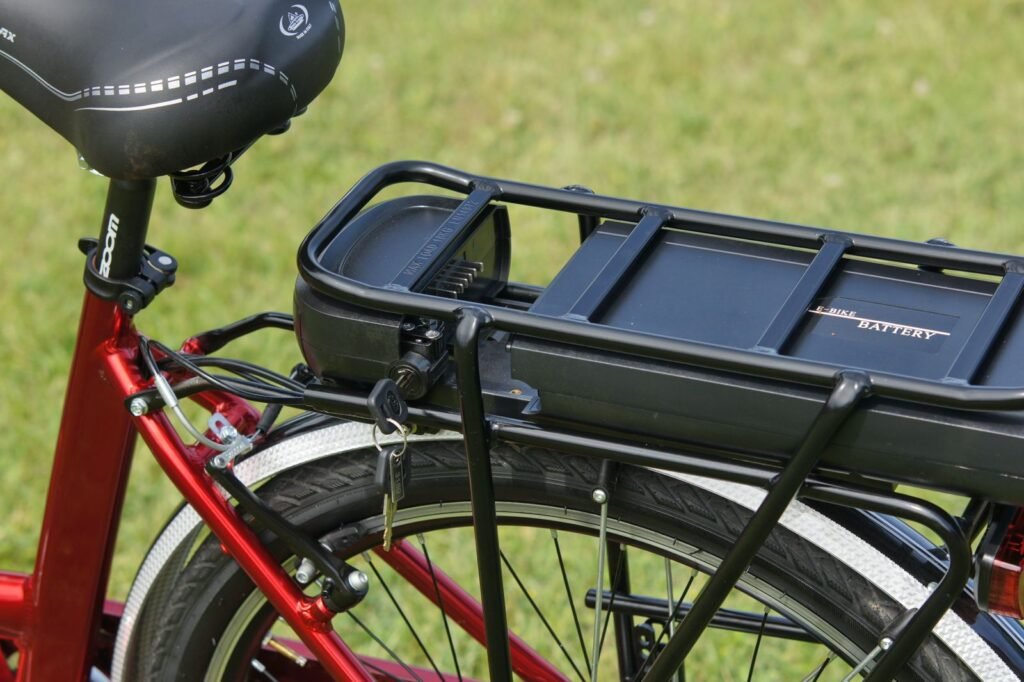
So how long do e-bike batteries last in years?
Batteries don’t fail on a date. They slowly lose capacity, so a pack that once gave you 40 miles gives you 32, then 28. Most riders replace a battery when the remaining range no longer covers their usual rides, not when it stops working.
Two things wear a battery down:
- Charge cycles. One full cycle is 100% of the battery’s capacity used and recharged. Two rides that each use half the battery add up to one cycle. Battery makers and bike shops commonly quote 500–1,000 full cycles before capacity drops to around 60–80% of new.
- Age and storage. Lithium-ion cells age even when they’re not used. Bosch notes that a battery gradually loses capacity even when you’re not riding. Heat and long periods at full or empty charge speed that up.
Put those together and you get the typical 3–5 year lifespan. A commuter who rides 20 miles a day and uses most of a battery every day can burn through cycles in a few years. A weekend rider might use under 100 cycles a year and see the battery age out from time before cycles.
| Rider | Full cycles per year (rough) | What usually limits life |
|---|---|---|
| Daily commuter, most of the battery each day | 200–300 | Cycle count; often 3–4 years |
| Several rides a week | 75–150 | Mix of cycles and age; often 4–6 years |
| Occasional weekend rider | Under 75 | Calendar aging and storage habits |
These are estimates to plan with, not guarantees. Check your bike’s manual or the battery maker’s documentation for its rated cycle life and warranty, which often run around two years.
How far will one charge take you?
The other half of how long do e-bike batteries last is range per charge, and you can estimate it yourself. You need two numbers:
- Battery capacity in watt-hours (Wh). It’s usually printed on the battery. If you only see volts and amp-hours, multiply them: a 48 V, 14 Ah battery holds 48 × 14 = 672 Wh.
- Your energy use in Wh per mile. As a rough guide, gentle riding in a low assist level on flat ground often uses around 10–15 Wh per mile. Mixed riding in middle assist often lands near 15–25. High assist, throttle use, hills, a heavy load or fast Class 3 speeds can push past 30.
A worked example
Say your bike has a 500 Wh battery and you ride a hilly commute in a middle assist level at about 20 Wh per mile:
500 Wh ÷ 20 Wh per mile = 25 miles. Keep a buffer of 10–20% so you aren’t pedaling a heavy bike home unassisted, and plan on roughly 20–22 usable miles. In eco mode on flat roads at 12 Wh per mile, the same battery could stretch past 40 miles.
Many bike displays show average Wh per mile or remaining range. After a few rides, use your own number instead of the estimate. It’s the most accurate range calculator you’ll ever have.
What drains range fastest
| Factor | Effect on range | What to do |
|---|---|---|
| Assist level and throttle | Biggest factor you control | Use eco or low assist on flats; save high assist for climbs |
| Speed | Wind resistance rises fast above about 20 mph | Cruise a few mph slower on long rides |
| Rider and cargo weight | More weight, more energy per mile, especially uphill | Plan on less range when hauling gear or kids |
| Hills and headwinds | Climbing uses far more energy than flat riding | Check elevation on new routes |
| Cold temperatures | Cold batteries deliver less energy | Store and charge indoors; install the battery right before riding |
| Low tire pressure | Soft tires add rolling resistance | Keep tires at the pressure printed on the sidewall |
| Stop-and-go riding | Every start from zero takes a burst of power | Pedal through starts instead of using the throttle |
If your rides regularly push past what a typical 400–500 Wh battery can do, a bigger battery matters more than a bigger motor. Our best long-range electric bikes are built around large-capacity packs.
Charging habits that make a battery last longer
How long do e-bike batteries last in practice comes down mostly to habits, because most battery wear is preventable. These are the habits I follow, backed by guidance from Bosch, the CPSC and battery safety groups:
- Avoid sitting at 100% or 0%. Lithium-ion cells are most stressed when completely full or completely empty. For daily riding, many riders keep the battery roughly between 20% and 80%. Tern’s guidance for Bosch batteries suggests charging to 80–90% unless you need full range, and recharging around 30–40% rather than running it flat.
- Store it at 30–60%. For storage longer than a few weeks, Bosch recommends a 30–60% charge, at room temperature, in a dry place. Check it every month or two and top it back up if it drops.
- Keep it out of heat. Don’t leave the bike in direct sun, a hot car or a summer attic. Tern’s Bosch guidance puts ideal storage near 68°F (20°C) and says to avoid storing below 32°F (0°C) or above 104°F (40°C).
- Charge at room temperature. In cold weather, bring the battery inside, let it warm up before charging, and put it on the bike just before you ride. Let a battery rest for a bit after a hard ride before charging, too.
- Use the original charger. The CPSC warns against “universal” chargers for micromobility devices; an incompatible charger can cause a battery fire. Use the charger that came with the bike or a replacement from the manufacturer.
- Unplug when it’s done. The CPSC advises not leaving the charger connected for long periods after the charge is complete.
Signs your e-bike battery is dying
Some signs just mean the battery is worn. Others mean it’s damaged and should be taken out of service right away.
Normal wear (plan a replacement)
- Range has dropped noticeably on your usual routes, at the same assist levels.
- The charge indicator falls quickly, or jumps from a few bars to almost empty.
- The motor cuts out under load (on a hill or a hard start) even though the display shows charge left.
- Your bike’s app or a dealer’s diagnostic test shows low remaining capacity. Shimano and Bosch dealers can check battery health.
Stop using it now
UL Standards & Engagement lists these warning signs: swelling or bulging, dents or punctures, leaking, unusual heat, a strange smell, smoke, or hissing or popping sounds. Also be careful with any battery that’s been through a crash or a hard drop, since UL notes that thermal runaway can happen hours or days later. Move a suspect battery outside, away from anything flammable, if you can do it safely, and call 911 if it smokes or catches fire.
Replacing a battery and charging safely
When it’s time to replace a battery, buy the manufacturer’s own replacement or one the manufacturer approves for your bike. The CPSC warns against packs that have been modified, rebuilt by unqualified people, or built with used cells.
Look for certification to recognized safety standards:
- UL 2849 covers the e-bike’s whole electrical system: battery, charger and motor/drive together.
- UL 2271 covers the battery pack itself.
A certified battery is much less likely to fail, but any lithium-ion battery can catch fire. These charging rules come from the CPSC and UL Standards & Engagement:
- Stay nearby while it charges. Don’t charge while you sleep or while you’re away from home. The CPSC says many deadly battery fires have started at night during charging.
- Charge away from exits. If a battery does fail, you don’t want it between you and the way out. Battery fires can leave less than a minute to escape, according to the Fire Safety Research Institute.
- Charge on a hard, clear surface away from beds, couches and anything flammable, with a working smoke alarm nearby.
- Plug the charger directly into a wall outlet, not a power strip or extension cord.
How to recycle an old e-bike battery
Never put an e-bike battery in household trash or curbside recycling. Damaged lithium-ion batteries can start fires in garbage trucks and recycling facilities.
- Use the industry program first. The e-bike battery recycling program that started as Call2Recycle with PeopleForBikes now runs as The Battery Network. Participating bike shops take back batteries from participating brands; use its drop-off locator and call the shop before you go.
- Otherwise, use household hazardous waste. The CPSC says to take lithium batteries to a battery recycler or hazardous waste collection center. Call first to confirm they accept e-bike batteries.
- Protect the terminals. Tape over exposed contacts and transport the battery so it can’t be crushed or short-circuited.
- Recalled battery? Follow the disposal instructions in the CPSC recall notice; some recalled packs can’t go to retail drop-off boxes.
The bottom line
So, how long do e-bike batteries last? Plan on several years and several hundred full cycles from a quality pack, with range shrinking gradually rather than all at once. Store it half-charged and cool, charge it with its own charger while you’re nearby, and it will reach the long end of that range. For daily riders picking a new bike, our best commuter electric bikes list battery size for each model, and you can browse every category in our e-bike reviews. If you’re shopping for a faster bike, check whether you need a license for an electric bike in your state first.
E-bike battery FAQ
How many years does an e-bike battery last?
Typically around 3 to 5 years, depending on how much you ride and how you store and charge it. Heavy daily use wears it out through charge cycles, while light use and poor storage (hot, full or empty) wear it out through aging.
How many charge cycles does an e-bike battery last?
Commonly 500 to 1,000 full charge cycles before capacity drops to around 60 to 80 percent of new. Shimano, for example, says its e-bike batteries keep 60 percent of their original capacity after 1,000 charges. Partial charges count as fractions of a cycle.
How long does an electric bike battery last on one charge?
Divide the battery’s watt-hours by your energy use per mile. A 500 Wh battery used at 20 Wh per mile gives about 25 miles. Low assist on flat ground can roughly double that, while hills, high assist and cold weather cut it.
Should I charge my e-bike battery after every ride?
You can, but for the longest life it’s better not to keep it at 100 percent for long. Charging to about 80 to 90 percent for everyday rides and recharging around 30 to 40 percent is a good routine. Charge to full before a long ride.
Is it OK to leave an e-bike battery charging overnight?
Safety agencies say no. The CPSC advises never charging micromobility batteries while you sleep or are away from home, because many battery fires have started at night during charging. Charge while you’re awake and nearby, then unplug.
How should I store an e-bike battery for winter?
Store it indoors at about 30 to 60 percent charge, in a dry room at moderate temperature, off the charger. Check it every month or two and top it up if it drops low. Don’t leave it in an unheated garage or shed.
How long do e-bikes last overall?
The frame, motor and components often outlast the first battery when the bike is maintained, so many riders replace the battery once or more over the bike’s life. Wear parts like chains, brake pads and tires need replacing far more often.
Sources
- Shimano e-bike battery capacity (via Propain service FAQ)
- Tern: How to care for your Bosch e-bike battery
- CPSC: Micromobility information center (e-bikes, e-scooters, hoverboards)
- UL Standards & Engagement: 5 e-bike and e-scooter safety tips
- Fire Safety Research Institute: Take C.H.A.R.G.E. of battery safety
- The Battery Network (formerly Call2Recycle): E-bike battery recycling