
How to Use a Jump Starter: Step-by-Step (Plus What to Do If It Won’t Start)
 By Ian Freng
Updated November 18, 2026
When I come back to the car after a few days at a cold trailhead, I’ve found that a dead battery is usually a slow drain, not a broken car, and a charged jump starter fixes it in about two minutes without waiting for another driver. The catch is that the pack has to be charged and you have to hook it up in the right order. Get either one wrong and you’re still stuck.
I’ve been prepping for 13 years and car camping for most of the 20 I’ve been hiking, and a portable jump starter (also called a jump box or battery booster) lives in my car year-round as part of my car emergency kit. This guide covers how to use a jump starter safely, what the buttons do, how to read what the car does when it won’t start, and how to keep the pack ready.
The short version
- Check first: car off, accessories off, and no cracked, leaking or frozen battery. Wear eye protection if you have it.
- Red clamp to the positive (+) terminal.
- Black clamp to unpainted metal on the engine block or chassis, or to the negative (-) terminal if your pack’s manual says so.
- Turn the pack on, wait for the ready light, then start the car.
- Crank for no more than about 5 seconds. If it doesn’t start, wait at least a minute before trying again.
- Once it runs, turn the pack off and remove black, then red. Drive the car, then recharge both the car battery and the pack.
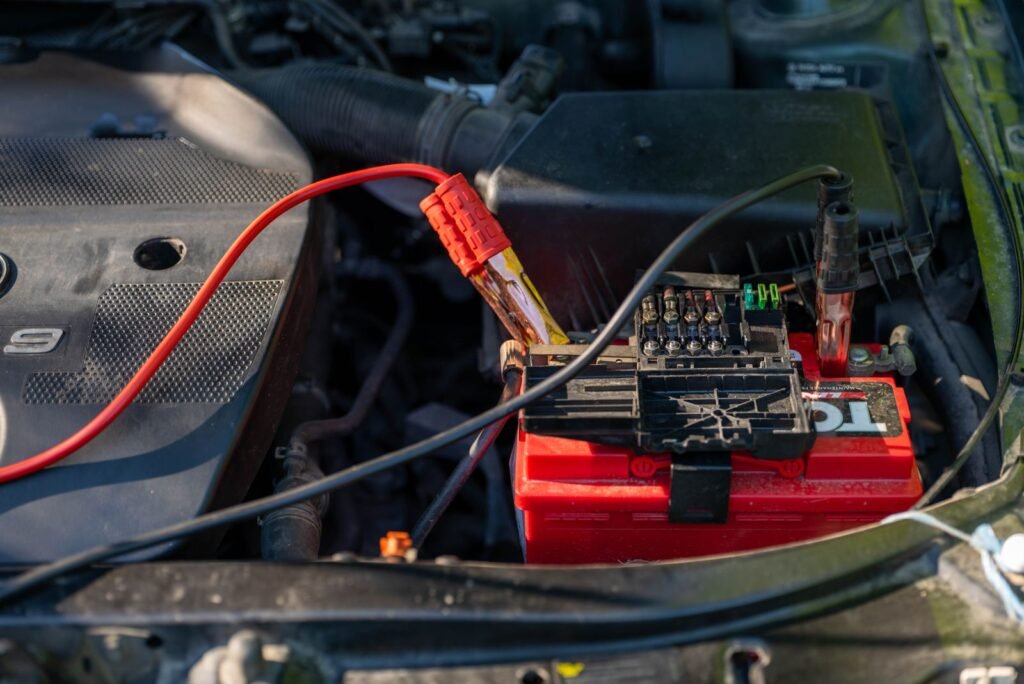
Safety checks before you clamp on
A jump starter is far safer than old-school jumper cables, because most modern packs won’t send power if the clamps are reversed. But a car battery is still a box of acid that can vent flammable gas. Take 30 seconds for these checks:
- Read the pack’s manual once, at home. Clamp placement, crank times and override buttons vary by model.
- Protect your eyes. Battery manufacturers recommend eye protection. Sunglasses are better than nothing.
- No smoking, sparks or flames near the battery, and keep your face from leaning directly over it.
- Look at the battery. AAA says not to jump a battery whose case is cracked or leaking. A swollen battery is another bad sign.
- Never jump a frozen battery. Jump starter manuals are consistent on this. If the case is bulging or you can see ice, let it warm up or replace it.
- Keep hands, hair and clamps clear of the fan, belts and pulleys, and never let the two clamps touch each other.
- Hybrids and EVs are different. Many have a small 12V battery you can jump, but AAA warns not to jump high-voltage systems. Follow your owner’s manual exactly.
How to use a jump starter, step by step
These steps work for nearly every 12V lithium or AGM jump box on a car, truck or SUV with a standard negative-ground system, which is almost all of them.
- Turn everything off. Ignition off, key out or push-button off, and lights, heater fan, radio and chargers off. Accessories pull power you need for cranking.
- Find the battery terminals. Some cars have the battery under a seat or in the trunk with remote jump posts under the hood. Your owner’s manual shows where.
- Make sure the pack is off before you connect anything.
- Connect the red clamp to the positive (+) terminal. It’s usually marked with a plus sign and often has a red cover.
- Connect the black clamp to a ground. The safest spot is solid, unpainted metal on the engine block or chassis, away from the battery. Many compact lithium packs allow the negative (-) terminal instead. Follow your pack’s manual.
- Turn the pack on. Wait for the green or “ready” light. If you see a red error light, recheck the clamps (see below).
- Start the car. Crank for about 3 to 5 seconds at most. Manuals range from 3 to 8 seconds, so use your pack’s number.
- If it doesn’t start, stop and wait. Give the pack at least a minute to cool before the next try (some manuals say 2 minutes). Most packs are good for a few attempts in a row before needing a longer rest.
- Once the engine runs, turn the pack off, then remove the black clamp first and the red clamp second. Don’t let the clamps touch while the pack is on.
- Leave the engine running and close the hood. Don’t shut it off right away.
That’s the whole job. The first time takes a few minutes; after that it’s about as fast as finding your keys.
What “boost” or “manual override” mode does
Most smart jump starters check the car battery’s voltage before sending power. It’s a safety feature: it’s why reversed clamps don’t spark. But if a battery is so dead it reads below about 2 to 3 volts, the pack can’t detect it and won’t turn on its output.
That’s what the boost or manual override button is for. You hold it for a few seconds (often 3) and the pack sends power anyway. On one major brand’s packs, override doesn’t add any power; it just skips the detection check. It also turns off reverse-polarity protection.
- Use it only when the clamps are definitely on the right terminals and the pack won’t power up on a deeply dead battery.
- Don’t use it if you’re unsure about polarity, if the clamps are touching anything but their correct points, or if the battery is damaged, frozen or leaking.
- Turn the pack off before removing the clamps, the same as a normal jump.
What to do if it won’t start
What the car does when you turn the key tells you a lot. Here’s how to read it:
| What you hear or see | What it usually means | What to try |
|---|---|---|
| Rapid clicking, dim dash lights | Not enough current reaching the starter. Poor clamp contact or a very weak pack. | Wiggle and reseat both clamps on clean metal. Check that the pack is charged. Wait a minute and try again. |
| A single click, then nothing | Power reaches the starter but it isn’t turning. Could be the starter, a bad connection or a battery with a dead cell. | Reseat the clamps and try once more. If it repeats, it’s likely beyond a jump. |
| No sound, no lights | No power getting through. Pack off, clamps not touching metal, or pack in protection mode. | Check the pack is on and shows ready. Clean corroded terminals. Consider boost mode only if polarity is certain. |
| Cranks normally but won’t fire | The battery is fine now. The problem is fuel, spark or something else. | Stop jumping. Repeated cranking won’t help and can overheat the starter. |
| Starts, then dies right away | Likely a charging system problem or a battery that can’t hold a charge. | Get the battery and alternator tested. |
AAA lists the usual suspects when a jump doesn’t work: the starter, the alternator, a blown fuse or a failed battery cell. If two or three properly connected attempts don’t do it, it’s time for roadside assistance.
How long to drive after a jump
AAA’s guidance is to drive or keep the car running for at least 30 minutes so the alternator can put some charge back in the battery. Highway driving charges better than idling or stop-and-go traffic, and running the heater, seat warmers and lights slows it down.
Treat 30 minutes as a minimum, not a fix. Battery maker Optima points out that alternators aren’t designed to fully recharge a deeply drained battery. The best move is to get the battery on a proper charger soon and have it tested. If it needed a jump with no obvious reason, like a dome light left on, it may be near the end of its life.
Recharging and storing the pack
Knowing how to use a jump starter doesn’t help if the pack is dead when you need it. Lithium packs hold a charge for months, but not forever.
- Recharge after every use.
- Top it up every 3 months in storage, which is what at least one major manufacturer’s manual recommends. Some say every 6 months; check yours and set a phone reminder.
- Mind the temperature. Extreme heat in a parked car shortens battery life, and extreme cold reduces output. In winter, a pack kept in the cabin or brought inside overnight cranks harder than one left in the trunk.
- Never charge a frozen pack. Let it warm to above freezing first.
- Keep the clamps stowed so they can’t touch each other or anything metal in the trunk.
Many packs double as a USB power bank and flashlight, which is handy, but every phone charge comes out of your cranking reserve. If yours also has a 12V outlet, it can power a small portable air compressor for a slow leak, though big inflation jobs drain it fast.
How big a jump starter do you need?
Jump starters are sized by peak amps, but peak amps aren’t measured the same way by every brand, so the more useful number is the maker’s rated engine size. Diesels need much more power than gas engines of the same size, and cold weather raises the requirement for both.
| Peak amps (approx.) | Gas engines up to | Diesel engines up to | Typical vehicles |
|---|---|---|---|
| 500A | 4.0L | Not recommended | Small cars, motorcycles |
| 1,000A | 6.0L | 3.0L | Most cars, crossovers and V6 SUVs |
| 1,500A | 7.0L | 4.5L | V8 SUVs and half-ton trucks |
| 2,000A | 8.0L | 6.0L | Large trucks, light diesels |
| 3,000A | 9.0L | 7.0L | Heavy-duty diesel trucks |
These figures come from one major brand’s published ratings and are approximate. Other brands rate their packs differently, so check the maker’s sizing guide for your exact engine. If you live where it gets well below freezing, or drive a diesel, size up one step.
Jump starter vs. jumper cables
| Jump starter | Jumper cables | |
|---|---|---|
| Needs a second car | No | Yes |
| Needs charging | Yes, every few months | Never |
| Reverse-polarity protection | On most smart packs | None |
| Extra uses | Often USB charging, flashlight | None |
| Best for | Solo drivers, remote trailheads, night | Backup that never goes dead |
For anyone who drives to trailheads, campsites or empty parking lots, a jump starter is the better tool, because there’s often no second car around. Cables are cheap and never need charging, so many people carry both.
Now that you know how to use a jump starter, see our picks in the best jump starter guide, and browse the rest of our car camping gear reviews.
How to use a jump starter FAQ
How do you use a jump box on a car?
Turn the car and accessories off. Connect the red clamp to the positive terminal and the black clamp to unpainted metal on the engine or chassis (or the negative terminal if your manual allows). Turn the jump box on, wait for the ready light, and crank for no more than about 5 seconds. Once it starts, turn the box off and remove black, then red.
Do you connect the black clamp to the negative terminal or ground?
Unpainted metal on the engine block or chassis is the classic, safest choice because any spark happens away from the battery. Many compact lithium jump starters say the negative terminal is fine. Follow your pack’s manual.
How long should you wait between jump start attempts?
At least a minute, and up to 2 minutes depending on the manual. Crank for no more than about 3 to 8 seconds per try, per your pack’s instructions. Waiting lets the pack and starter cool.
Why is my car just clicking with the jump starter connected?
Rapid clicking usually means not enough current is reaching the starter. Reseat both clamps on clean metal, make sure the pack is charged, and try again. A single click with no crank often points to the starter or a failed battery.
Should I use boost or manual override mode?
Only if the battery is so dead the pack won’t detect it and you’re certain the clamps are on the right terminals. Override bypasses the safety checks, including reverse-polarity protection.
How often should I charge my jump starter?
After every use and at least every 3 months in storage, unless your manual says otherwise. Bring it inside in very cold weather and never charge it while frozen.
How long do I need to drive after using a jump starter?
At least 30 minutes, ideally on the highway. Then get the battery on a charger and tested, since a drive won’t fully recharge a deeply drained battery.