The Best Generators for Home Backup Power (2026)
 By Ian Freng
Updated November 18, 2026
When I plan for multi-day power outages, I’ve found that where a generator sits matters as much as which one you buy: the CDC says to run it outdoors, more than 20 feet from your home, doors and windows, and never in a garage, even with the door open. Choosing the best generator for home backup comes down to three questions: how many watts you really need, which fuel you can store safely, and how you will connect it to your house. Below are five picks that cover every situation, from a budget gas generator for the fridge to a transfer switch ready dual fuel unit that can run whole circuits, plus a battery option that is safe to use indoors. Every gas pick here has an automatic carbon monoxide shutoff.
Quick answer: Our top pick is the Westinghouse WGen9500DFc (best overall). A big dual fuel generator with a 240V twist-lock outlet that can back up whole household circuits through a transfer switch.
- Best dual fuel value: Champion 4750W Dual Fuel
- Best inverter / quiet: Honda EU2200i
- Best budget: Generac GP3600
- Best indoor-safe battery alternative: EcoFlow DELTA 3 Classic + 220W
Best generator for home backup: picks compared
| Product | Running watts | Starting watts | Fuel | CO shutoff | Buy |
|---|---|---|---|---|---|
 Westinghouse WGen9500DFc
Best overall |
9,500W gas / 8,500W propane | 12,500W gas / 11,200W propane | Gasoline or propane | Yes (CO sensor) | $1,049.00 at Amazon |
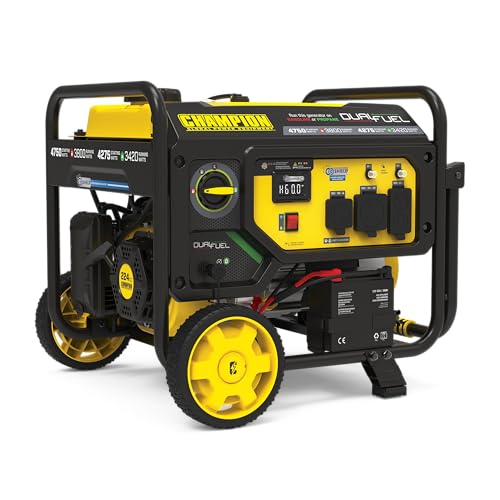 Champion 4750W Dual Fuel
Best dual fuel value |
3,800W gas / 3,420W propane | 4,750W gas / 4,275W propane | Gasoline or propane | Yes (CO Shield) | $629.10 at Amazon |
 Honda EU2200i
Best inverter / quiet |
1,800W | 2,200W (max) | Gasoline | Yes (CO-MINDER) | $1,199.00 at Amazon |
 Generac GP3600
Best budget |
3,600W | 4,500W | Gasoline | Yes (COsense) | $549.00 at Amazon |
 EcoFlow DELTA 3 Classic + 220W
Best indoor-safe battery alternative |
1,800W (AC output) | 3,600W surge | Battery + solar (1,024Wh) | Not needed (no exhaust) | $949.00 at Amazon |
Amazon price as of Nov 18, 2026 12:07 am GMT+0000. Prices and availability are accurate as of the date/time indicated and are subject to change.
We may earn a commission when you buy through links on this page, at no extra cost to you. As an Amazon Associate we earn from qualifying purchases.
Quick picks
- Best overall: Westinghouse WGen9500DFc: enough power to run whole circuits through a transfer switch, on gas or propane.
- Best dual fuel value: Champion 4750W Dual Fuel: gas or propane, electric start and long run time in a mid-size generator.
- Best inverter / quiet: Honda EU2200i: a quiet, fuel-sipping inverter for lights, electronics and small loads.
- Best budget: Generac GP3600: a basic gas generator with enough power for a fridge and the essentials.
- Best indoor-safe battery alternative: EcoFlow DELTA 3 Classic + 220W: a silent, fume-free battery you can use indoors, rechargeable from solar.
How I picked these
I’ve been prepping for 13 years, and backup power is the part of a home plan that people most often get wrong: too little generator for the fridge and furnace, too much to afford fuel for, or a good generator run in an unsafe spot. I compared these generators on running and starting watts, fuel options, run time, noise, how they connect to a house and, above all, carbon monoxide protection. Specs come from each manufacturer’s own product pages.
I only picked gas generators with an automatic CO shutoff (Westinghouse’s CO sensor, Champion CO Shield, Honda CO-MINDER and Generac COsense). The U.S. Consumer Product Safety Commission recommends buying a generator with a CO shut-off feature, and it is the single most important feature on this list. Watch for look-alike model numbers: the plain Westinghouse WGen9500DF, for example, has no CO sensor, while the WGen9500DFc does.
1. Westinghouse WGen9500DFc: best overall
Westinghouse WGen9500DFc Dual Fuel Portable Generator with CO Sensor
A big dual fuel generator with a 240V twist-lock outlet that can back up whole household circuits through a transfer switch.
- Running watts 9,500W gas / 8,500W propane
- Starting watts 12,500W gas / 11,200W propane
- Fuel Gasoline or propane
- CO shutoff Yes (CO sensor)
What we like
- 9,500 running watts on gasoline (8,500 on propane)
- Transfer switch ready L14-30R 120/240V outlet
- CO sensor with automatic shutdown
- Remote electric start
- About 12 hours at 25% load on gasoline
What we don't
- Large and heavy to move
- Transfer switch needs a licensed electrician
- Burns more fuel than smaller units
Amazon price as of Nov 18, 2026 12:07 am GMT+0000. Prices and availability are accurate as of the date/time indicated and are subject to change.
The Westinghouse WGen9500DFc is the generator to look at if you want more than a fridge and a few lamps. With 9,500 running watts on gasoline and 12,500 peak watts, it has room for a refrigerator, a well pump or sump pump, a furnace blower, lights and a window air conditioner at the same time, as long as you add up the wattages first.
The key feature is the L14-30R 120/240V twist-lock outlet. Connected to a properly installed transfer switch or inlet, it can power whole circuits in your panel, including 240V loads like many well pumps, instead of a tangle of extension cords. It runs on gasoline or propane, starts with a remote, and its CO sensor shuts the engine down automatically if carbon monoxide builds up around it. Make sure you buy the DFc model: the plain WGen9500DF does not have the CO sensor.
Where it falls short: it’s big, and the transfer switch or inlet it’s designed for has to be installed by a licensed electrician. A generator this size also uses more fuel, so plan your fuel storage before an outage.
2. Champion 4750W Dual Fuel: best dual fuel value
Champion 4750-Watt Electric Start Dual Fuel Generator with CO Shield (201393)
A mid-size dual fuel generator with electric start, long run time and CO Shield automatic shutoff.
- Running watts 3,800W gas / 3,420W propane
- Starting watts 4,750W gas / 4,275W propane
- Fuel Gasoline or propane
- CO shutoff Yes (CO Shield)
What we like
- Runs on gasoline or propane
- Up to 14 hours at 50% load on a full 4.7 gal tank
- 10.5 hours on a 20 lb propane tank
- Push-button electric start, battery included
- CO Shield auto-shutoff
What we don't
- 68 dB(A): louder than an inverter
- No 240V twist-lock outlet, so it isn't a whole-panel solution
Amazon price as of Nov 18, 2026 12:07 am GMT+0000. Prices and availability are accurate as of the date/time indicated and are subject to change.
The Champion 201393 hits the sweet spot for a lot of households: enough power for the essentials during an outage, dual fuel flexibility, and run times that let you sleep through the night. Champion rates it at 3,800 running watts and 4,750 starting watts on gasoline, with up to 14 hours at half load on a full 4.7 gallon tank.
On propane it runs about 10.5 hours on a standard 20 lb tank, the same kind you use for a grill. That matters because propane stores far better than gasoline, so you can keep a few tanks on hand without worrying about stale fuel. Push-button electric start makes it easy to use in the cold, and CO Shield shuts it off automatically if carbon monoxide builds up. It has a TT-30R outlet and 5-20R household outlets.
Where it falls short: at 68 dB(A) it’s noticeably louder than the Honda inverter, and it has no 240V outlet, so it can’t back up whole circuits like the Westinghouse.
3. Honda EU2200i: best inverter / quiet
Honda EU2200i Inverter Generator with CO-MINDER
A quiet, light inverter generator for essentials, with Honda's CO-MINDER automatic shutdown.
- Running watts 1,800W
- Starting watts 2,200W (max)
- Fuel Gasoline
- CO shutoff Yes (CO-MINDER)
What we like
- As low as 48 dB(A) at 1/4 load
- 8.1 hours at 1/4 load on 0.95 gal of gas
- 47.4 lb dry weight
- CO-MINDER automatic shutdown
What we don't
- 1,800 running watts: essentials only
- Gasoline only
- Small tank means more refueling at higher loads
Amazon price as of Nov 18, 2026 12:07 am GMT+0000. Prices and availability are accurate as of the date/time indicated and are subject to change.
The Honda EU2200i is the quietest and lightest generator on this page. Honda rates it at 1,800 watts running and 2,200 watts max, and it’s as quiet as 48 dB(A) at a quarter load, so it won’t keep you or the neighbors up during a long outage. At 47.4 lb, one person can carry it.
It’s very easy on fuel: about 8.1 hours on less than a gallon at a quarter load, or 3.2 hours at full rated load. That makes it a good fit for lights, phone and laptop charging, a TV, fans, a CPAP and other small loads. Honda’s CO-MINDER monitors carbon monoxide and shuts the engine down before levels near it get dangerously high.
Where it falls short: 1,800 running watts covers essentials, not your whole house. A refrigerator’s starting surge can be large, so check your fridge’s label before relying on a small inverter for it, and it runs on gasoline only.
4. Generac GP3600: best budget
Generac GP3600 Portable Generator with COsense (Model 7721)
A simple, affordable gas generator from a well-known backup power brand, with COsense CO shutdown.
- Running watts 3,600W
- Starting watts 4,500W
- Fuel Gasoline
- CO shutoff Yes (COsense)
What we like
- 3,600 running / 4,500 starting watts
- About 9.3 hours at 50% load
- 3.7 gallon tank
- COsense CO shutdown
What we don't
- Recoil (pull) start only
- Heavy at 105 lb
- Gasoline only
Amazon price as of Nov 18, 2026 12:07 am GMT+0000. Prices and availability are accurate as of the date/time indicated and are subject to change.
The Generac GP3600 is a straightforward way to keep the refrigerator, freezer, lights and phones running through an outage. Generac rates it at 3,600 running watts and 4,500 starting watts, with about 9.3 hours of run time at half load on its 3.7 gallon tank.
Generac’s COsense technology shuts the generator down if dangerous carbon monoxide levels are detected, which is exactly the feature to insist on in a budget generator. If you mainly need to protect the food in your fridge and freezer and keep a few rooms lit, it does the job without paying for features you won’t use.
Where it falls short: it’s pull start only, which some people find hard in the cold, it weighs 105 lb, and it runs on gasoline only, so you’ll need to rotate stored fuel.
5. EcoFlow DELTA 3 Classic + 220W: best indoor-safe battery alternative
EcoFlow DELTA 3 Classic Portable Power Station with 220W Solar Panel
A 1,024Wh battery power station with a 220W solar panel: no fuel, no fumes, safe to run inside.
- Running watts 1,800W (AC output)
- Starting watts 3,600W surge
- Fuel Battery + solar (1,024Wh)
- CO shutoff Not needed (no exhaust)
What we like
- No exhaust: safe to use indoors
- 1,024Wh LiFePO4 battery, 1,800W output (3,600W surge)
- Under 10 ms UPS-style switchover
- Recharges from solar, wall or car
What we don't
- Far less energy than a tank of fuel
- Expensive for the capacity
- Heavy for its size
Amazon price as of Nov 18, 2026 12:07 am GMT+0000. Prices and availability are accurate as of the date/time indicated and are subject to change.
Not everyone can safely run a gas generator. If you live in an apartment or condo, have no safe spot 20 feet from the house, or mainly need to keep a CPAP, phones, a modem and a few lights going, a battery power station is the safer choice. The EcoFlow DELTA 3 Classic stores 1,024Wh in a long-life LiFePO4 battery, puts out 1,800W (3,600W surge), and switches over in under 10 milliseconds, like a UPS, when the power drops.
This bundle includes a 220W solar panel, so you can recharge during a long outage without any fuel. For more battery options, see our full guide to the best solar generators.
Where it falls short: a 1,024Wh battery holds far less energy than a tank of gasoline, so it won’t run heavy loads like a space heater or window AC for long, and it costs more per watt-hour of backup than a gas generator.
How to choose the best generator for home backup
- Watts: add up the running watts of everything you want to power at once, then add the highest single starting watt figure. That number, plus some headroom, is your minimum size (worked example below).
- Fuel: gasoline is everywhere but goes stale in storage. Dual fuel generators also run on propane, which stores well in standard tanks. Batteries need no fuel at all but hold much less energy.
- Connection: extension cords work for a few appliances. To power hardwired loads like a furnace blower or well pump, you need a transfer switch or inlet installed by a licensed electrician, and a generator with a matching outlet, such as an L14-30R.
- CO protection: buy a generator with an automatic carbon monoxide shutoff. Every gas generator on this page has one.
- Noise and weight: inverters are much quieter and lighter. Big open-frame generators are louder and usually need wheels.
- Starting: electric start is much easier in cold weather than a pull cord.
How to size a generator: a worked example
Every appliance has two numbers. Running watts is the steady power it needs once it’s on. Starting watts is the extra surge some appliances need for a moment when a motor or compressor kicks on. Champion’s generator sizing guide puts it simply: total the running watts of everything you’ll power, then add the highest single starting watt figure. You only add one starting figure because motors rarely start at the exact same moment.
Here’s an example using Champion’s published reference wattages: a refrigerator (400 running, 2,200 starting), a window air conditioner (1,200 running, 2,000 starting), a microwave (800 running, 2,000 starting) and an LED TV (80 running). The running watts add up to 2,480. The highest single starting figure is the refrigerator’s 2,200, so you need about 2,480 + 2,200 = 4,680 starting watts.
That load fits the Champion dual fuel (3,800 running, 4,750 starting on gas) with little room to spare, and it’s too much for the Generac GP3600’s 4,500 starting watts unless you skip the microwave while the AC is running. Drop the air conditioner and the same list needs about 1,280 running and 3,480 starting watts, which the Generac handles easily. Reference charts are estimates: always check the label or manual on your own appliances, especially motor loads like furnace blowers, sump pumps and well pumps, which vary a lot by model.
Inverter vs. conventional generators
A conventional generator runs its engine at a constant speed to make power. That makes it simple and inexpensive per watt, but it’s loud and burns fuel at a steady rate even when you’re barely using it. The Westinghouse, Champion and Generac on this page are conventional generators.
An inverter generator, like the Honda EU2200i, converts power electronically and can throttle the engine up and down with the load. That’s why it’s so much quieter and goes so much further on a gallon at light loads. Inverters are usually smaller, so they’re best for essentials, camping and RVs, while conventional generators give you more watts for the money for whole-home backup.
Dual fuel and propane storage
A dual fuel generator runs on gasoline or propane, and that flexibility is a big advantage in a long outage. Gas stations need power to pump fuel, so the gasoline you have stored is often all you get for the first few days. Propane in standard 20 lb tanks stores well for long periods, doesn’t need stabilizer, and is easy to swap at many stores and gas stations.
Generators make a little less power on propane. Champion’s 201393, for example, drops from 3,800 to 3,420 running watts, and the Westinghouse drops from 9,500 to 8,500. Factor that into your sizing if propane will be your main fuel. Store propane tanks outdoors, upright, away from the house and never in a basement or garage.
Transfer switch vs. extension cords (and why you never backfeed)
The simplest setup is heavy-duty outdoor extension cords from the generator to the appliances you need. It works for a refrigerator, lamps and chargers, but not for anything hardwired, like a furnace blower, well pump or hardwired lights. Use cords rated for the load and run them so they aren’t a trip hazard or pinched in a door.
To power hardwired circuits, have a licensed electrician install a transfer switch or a generator inlet with an interlock on your panel. You plug the generator into an outdoor inlet, and the switch disconnects your house from the grid before generator power flows in. OSHA says never to attach a generator to a building’s electrical system unless a qualified electrician has installed it with a transfer switch.
Never backfeed by plugging a generator into a wall outlet with a double-ended (“suicide”) cord. The CPSC warns that backfeeding can send power back onto the utility lines and electrocute line workers and neighbors, and it can also start a fire in your home.
Carbon monoxide safety: the rules that save lives
- Outdoors only. The CDC says never to run a generator inside your home, basement, crawl space, garage or carport, even with the doors or windows open.
- More than 20 feet away. Keep the generator more than 20 feet from your home, doors and windows, with the exhaust pointed away from the house.
- Install CO alarms. Put battery-powered or battery backup carbon monoxide alarms on every level of your home and outside sleeping areas, and test them before storm season.
- Buy CO shutoff. The CPSC reports about 100 deaths a year in the U.S. from portable generator carbon monoxide and recommends generators with a CO shut-off feature.
- Know the symptoms. Headache, dizziness, weakness, nausea and confusion can mean CO poisoning. Get to fresh air right away and call 911.
- Keep it dry. Don’t run a generator in the rain or standing water without a cover designed for running generators.
Fuel storage basics
- Store gasoline only in approved fuel containers, in a detached shed or well-ventilated area away from living spaces and anything that makes a spark or flame.
- Untreated gasoline can go stale within a few months. Add fuel stabilizer when you fill your cans, and use the oldest fuel first by running it through your car.
- Turn the generator off and let it cool before refueling. Gasoline spilled on a hot engine can ignite.
- Plan how much fuel you’ll need: divide your tank size by the run time at your expected load, then multiply by the hours per day you’ll run it and the days you want to cover.
- Check local rules: many areas limit how much gasoline or propane you can store at home.
Generator maintenance: run it every month
- Exercise it monthly. Start your generator and run it under some load for about 15 to 20 minutes every month or so. It keeps seals lubricated, charges the starting battery on electric start models, and tells you about problems before an outage does.
- Change the oil on the schedule in your owner’s manual, including the short break-in change on a new generator.
- Don’t store old gas in the carburetor. For long storage, use stabilized fuel or run the carburetor dry, as your manual recommends. Gummed carburetors are one of the most common reasons a generator won’t start after sitting.
- Keep spares: a spark plug, an air filter, the right oil and a funnel.
- Test your setup, cords and transfer switch included, before storm season, not during the first outage.
Generator, power station or both?
Gas generators and battery power stations solve different problems. A generator turns fuel into lots of power for as long as you can keep it fueled, which is what you need for a refrigerator, freezer, well pump or furnace over several days. A battery power station is silent, has no exhaust and can run indoors, but it holds a fixed amount of energy unless you recharge it from solar or a generator.
Many prepared households use both: a gas generator outside for the heavy loads during the day, and a power station inside for a CPAP, phones, lights and the internet overnight while the generator is off. For smaller backup, see our guides to the best power banks for power outages and best solar generators.
Portable vs. standby generators
A standby generator is permanently installed next to your house, runs on natural gas or a large propane tank, and starts automatically when the power goes out. It’s the most convenient option and can power an entire home, but it requires professional installation, permits and a much bigger budget.
A portable generator, like every gas pick on this page, costs far less and can be moved, stored and used for other jobs. Paired with a transfer switch, a large portable generator like the Westinghouse WGen9500DFc can cover most of what a standby unit does, as long as you’re home to start it, fuel it and run it safely.
Home backup generator FAQ
What is the best generator for home backup?
For most homes that want to run whole circuits through a transfer switch, the Westinghouse WGen9500DFc is the best generator for home backup: 9,500 running watts, gas or propane, a 240V twist-lock outlet and a CO sensor. If you only need the essentials, the Champion 4750W dual fuel is a strong value, and the Honda EU2200i is the quiet pick for small loads.
What size generator do I need to run a house?
Add up the running watts of everything you want to run at the same time, then add the single highest starting watt figure. Using Champion’s reference wattages, a refrigerator, a microwave, an LED TV and a few lights come to about 1,300 running watts and 3,500 starting watts, which a mid-size generator handles. Adding a window AC, well pump or furnace blower, or running whole circuits through a transfer switch, pushes you toward a large generator like the Westinghouse. Central air and electric water heaters, ranges and dryers need much more, so check their labels.
Can I run a generator in my garage with the door open?
No. The CDC and CPSC both say never to run a generator in a garage or carport, even with the door open. Carbon monoxide can build up fast and seep into the house. Run it outdoors, more than 20 feet from your home, doors and windows.
Can I plug a generator into a wall outlet?
No. That’s called backfeeding, and it can electrocute utility workers and neighbors and damage your home’s wiring. Use extension cords to individual appliances, or have a licensed electrician install a transfer switch or inlet with an interlock.
Is a dual fuel generator worth it?
For home backup, usually yes. Propane stores well in standard tanks without going stale, and it gives you a second fuel when gas stations are closed or out after a storm. You give up a little power on propane, so size with the propane wattage if you’ll rely on it.
How long can a generator run continuously?
As long as you keep it fueled and maintained, but plan for refueling and breaks. Run time per tank depends on load: Champion rates its 201393 at up to 14 hours at half load on gasoline, and Honda rates the EU2200i at 8.1 hours at a quarter load. Always turn the generator off and let it cool before refueling, and check the oil during long outages.
Final thoughts on home backup generators
If you want to back up real household circuits, the Westinghouse WGen9500DFc with a professionally installed transfer switch is the best generator for home backup on this list. The Champion 4750W dual fuel covers the essentials with propane flexibility, the Honda EU2200i is the quiet, light choice for small loads, and the Generac GP3600 keeps the fridge cold on a budget. If you can’t run a gas generator safely, the EcoFlow DELTA 3 Classic is the indoor-safe option.
Whatever you choose, size it with the wattage method above, keep it outdoors and more than 20 feet from the house, install CO alarms, and run it every month. For the rest of your plan, see what to do during a power outage, our emergency preparedness kit list and how to prepare for a winter storm.