
Emergency Preparedness Kit List: What to Put in Your Home Kit
 By Ian Freng
Updated November 17, 2026
When I restock my emergency preparedness kit, I’ve found that batteries are the first thing to go bad, not the food. Alkaline batteries left inside a flashlight or radio for a year or two can leak and corrode the contacts, so the light you’re counting on is dead when you finally need it. I store batteries in their packaging, next to the devices, not inside them.
That’s the kind of detail that separates a kit that works from a box of stuff in the garage. I’ve been prepping for 13 years, and this checklist is built on the official guidance from Ready.gov (FEMA) and the American Red Cross, organized the way I actually pack mine. It covers how much water and food you need per person, the full list by category, the difference between a go bag and a home kit, and how to keep everything fresh.
The short version
- Water: 1 gallon per person per day. Red Cross guidance is a 3-day supply for evacuation and a 2-week supply at home.
- Food: non-perishable food you’ll actually eat, plus a manual can opener.
- Light and power: flashlights or headlamps, extra batteries, and a power bank for phones.
- Information: a battery or hand-crank radio with NOAA weather alerts.
- Health: a first aid kit and at least a 7-day supply of any medications.
- Basics people forget: a whistle, dust masks, wrench or pliers for utilities, garbage bags and copies of important documents.
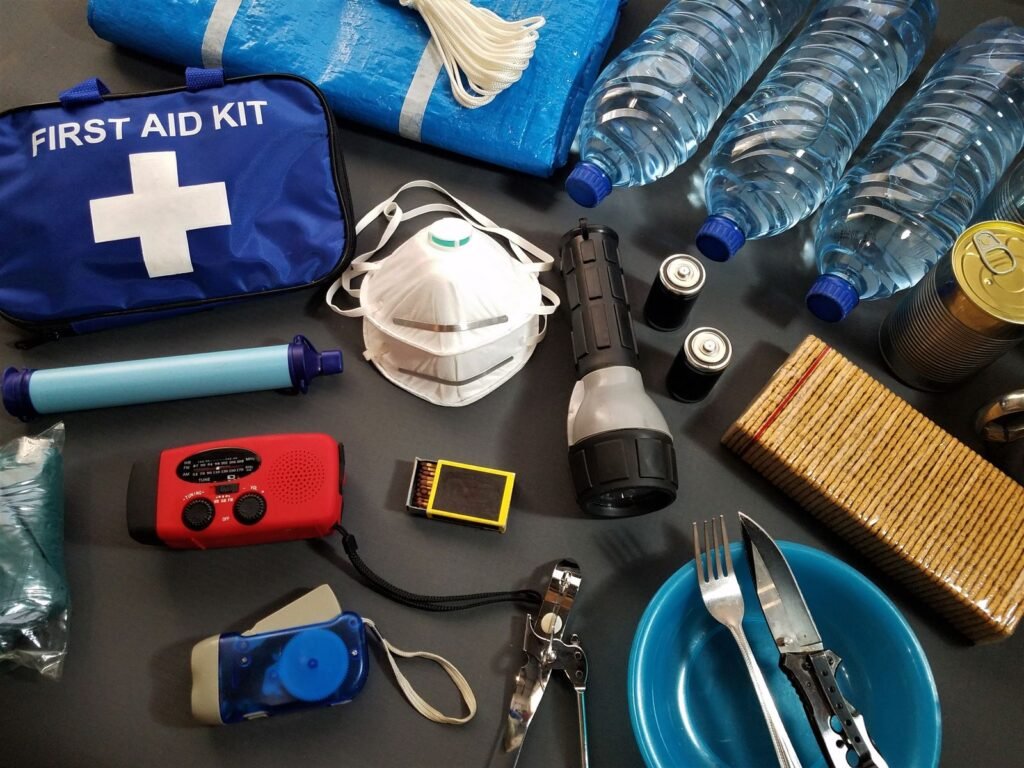
How much water and food do you need?
Ready.gov recommends at least one gallon of water per person per day for several days, for drinking and sanitation, and at least a several-day supply of non-perishable food. The Red Cross puts numbers on it: a 3-day supply in a kit you can carry if you have to evacuate, and a 2-week supply at home, because stores and pharmacies may be closed after a major disaster.
Water is the bulky part, so here’s what those guidelines mean for your household:
| People in your home | 3-day water (go kit) | 2-week water (home) |
|---|---|---|
| 1 | 3 gallons | 14 gallons |
| 2 | 6 gallons | 28 gallons |
| 3 | 9 gallons | 42 gallons |
| 4 | 12 gallons | 56 gallons |
| 5 | 15 gallons | 70 gallons |
Add more for pets, nursing mothers, sick people and hot weather. Ready.gov notes that water needs can double in very hot temperatures. A normally active adult needs about three quarters of a gallon of fluid a day; the rest of the gallon covers cooking and basic hygiene.
The emergency preparedness kit list
Check items off as you go. The first group in each section is the essentials; the rest are worth adding once the basics are covered.
Water
- ☐ 1 gallon per person per day (see the table above) in sealed commercial bottles or food-grade water storage containers
- ☐ Extra water for pets
- ☐ A way to treat water if your supply runs out: unscented bleach, a water filter, or both (here’s how to purify water)
Food
- ☐ Non-perishable food that needs little or no cooking: canned meat, beans, soup, peanut butter, crackers, dried fruit, nuts
- ☐ Manual can opener
- ☐ Long shelf-life emergency food or freeze-dried meals for the 2-week home supply
- ☐ Paper plates, cups and utensils (dish water is wasted water)
- ☐ Baby formula and food, if needed
- ☐ Pet food, if needed
Not sure how much to store? Our guide to how much food to stockpile per person walks through the math.
Light and power
- ☐ A flashlight for every person, or a headlamp to keep your hands free
- ☐ A battery lantern to light a whole room
- ☐ Extra batteries in their original packaging
- ☐ A charged power bank and charging cables for every phone
- ☐ Optional for long outages: a portable power station or solar generator
Communication and information
- ☐ A battery-powered or hand-crank emergency radio with NOAA weather alerts
- ☐ A whistle for each person, to signal for help
- ☐ Paper list of important phone numbers (your phone may be dead)
- ☐ Local paper maps, marked with two evacuation routes
- ☐ Optional: two-way radios so your family can talk when cell service is down
First aid and medications
- ☐ A well-stocked first aid kit
- ☐ At least a 7-day supply of prescription medications (the Red Cross minimum; more is better for a home kit)
- ☐ Over-the-counter basics: pain reliever, antihistamine, anti-diarrheal, electrolyte packets
- ☐ Spare glasses or contacts and solution
- ☐ Hearing aid batteries and any medical supplies you rely on
Sanitation and hygiene
- ☐ Moist towelettes and hand sanitizer
- ☐ Heavy-duty garbage bags and plastic ties (Ready.gov lists these for personal sanitation)
- ☐ Toilet paper and feminine supplies
- ☐ A bucket with a lid: lined with a garbage bag, it works as an emergency toilet if water service stops
Tools and shelter-in-place supplies
- ☐ Wrench or pliers to turn off gas and water
- ☐ A multi-tool
- ☐ Dust masks (N95 or similar)
- ☐ Plastic sheeting, scissors and duct tape
- ☐ Matches in a waterproof container or a reliable fire starter
- ☐ A fire extinguisher
Documents and money
- ☐ Copies of IDs, insurance policies, deeds or leases, and medical information in a waterproof bag
- ☐ A USB drive or secure cloud copy of the same documents
- ☐ Cash in small bills (card readers and ATMs go down with the power)
Warmth and clothing
- ☐ A blanket or sleeping bag for each person
- ☐ A complete change of clothes and sturdy shoes for each person
- ☐ Rain gear
- ☐ In winter: hats, gloves and hand warmers
For kids, older adults and pets
- ☐ Diapers, wipes and comfort items for kids
- ☐ Books, cards or games (a long outage is boring, and boredom makes kids miserable)
- ☐ Extra medical supplies and mobility aids for older family members
- ☐ Pet carrier, leash, food, water bowls and vaccination records
Go bag vs. home kit: do you need both?
Yes, if you can. They solve different problems.
A go bag is what you grab when you have to leave in minutes: a fire, a flood warning, a gas leak. It holds the 3-day supply, it has to be light enough to carry, and it lives by the door or in the car. A bug out bag is the more rugged version of the same idea; here’s our complete bug out bag list.
A home kit is what lets you stay put for up to two weeks: a winter storm, a long power outage, a boil-water order. It’s bigger and heavier, and it can include things you’d never carry, like cases of water, a power station and a camp stove for outdoor use.
If you’re starting from zero, build the go bag first. It covers the most dangerous scenarios, and everything in it also counts toward your home kit. A pre-made survival kit is a quick way to get a go bag started, but check what’s inside and add water, medications and documents yourself.
Where to keep your kit and how to keep it fresh
Store your home kit somewhere cool, dark and easy to reach: a hall closet or under a bed beats a hot attic or a garage that hits 100°F in summer. Heat shortens the life of batteries, food and medications. Ready.gov also suggests smaller kits at work and in the car, since you may not be home when something happens.
Then put two reminders on your calendar, six months apart. At each one:
- ☐ Replace any water you bottled yourself. Ready.gov says to replace water that wasn’t commercially bottled every six months.
- ☐ Eat and replace food that’s within a few months of its date.
- ☐ Check that medications haven’t expired and that your prescriptions still match.
- ☐ Test every flashlight and radio, and recharge power banks.
- ☐ Update clothes and diapers for growing kids, and your contact list.
Winter additions to your kit
Winter storms are the most common reason people end up living out of their kit, usually because the power goes out in the cold. On top of the list above, add extra blankets or sleeping bags rated for cold, hand warmers, and a plan for one warm room in the house. Never use a grill, camp stove or generator indoors or in a garage; carbon monoxide kills people every winter during outages. Our guide to what to do during a power outage covers staying warm safely.
Keep a smaller kit in the car too (here’s our full car emergency kit list). Ready.gov’s car kit adds jumper cables, flares or a reflective triangle, an ice scraper, a car phone charger, a blanket, a map, and cat litter or sand for traction. A portable jump starter is easier and safer than cables when you’re alone. Expecting snow and ice? Read how to prepare for a winter storm.
Emergency preparedness kit FAQ
How much water should be in an emergency preparedness kit?
Plan on at least one gallon per person per day, for drinking and sanitation. The Red Cross recommends a 3-day supply for evacuation and a 2-week supply at home, which is 3 and 14 gallons per person. Add more for pets and hot weather.
How long does stored water last?
Ready.gov says to replace water that wasn’t commercially bottled every six months. Commercially bottled water should be kept sealed in its original container in a cool, dark place.
What are the most important items in an emergency kit?
Water, non-perishable food, a flashlight with extra batteries, a battery or hand-crank radio with NOAA alerts, a first aid kit, medications, and a phone charger or power bank. Those cover the problems that hurt people fastest in most emergencies.
Should I buy a pre-made emergency kit?
A pre-made kit is a fast start, especially for a go bag, but none of them are complete. You’ll still need to add water, a few days of food you’ll actually eat, your medications, copies of documents and anything specific to your family.
How often should I check my emergency kit?
Every six months. Replace self-bottled water, rotate food and medications, test lights and radios, and recharge power banks. Many people do it when the clocks change in spring and fall.
What’s the difference between a go bag and an emergency kit?
A go bag is a light, 3-day kit you can grab and carry if you have to evacuate. A home emergency kit is a larger supply, ideally two weeks, for sheltering in place during storms and long outages.