
How to Store Water Long Term: Amounts, Containers, Bleach and Rotation
 By Ian Freng
Updated November 18, 2026
When I plan water for a multi-day backpacking trip, I’ve found that it’s the heaviest thing I carry, at roughly 8.3 pounds per gallon. That same weight math matters at home. A full 55-gallon drum weighs more than 450 pounds, so pick its spot before you fill it, because you won’t be moving it afterward.
I’ve been prepping for 13 years, and water is always where I tell people to start. You can go a long time without food, but not without water. This guide covers how to store water long term the way the CDC, Ready.gov and the EPA recommend: how much, what to put it in, how to sanitize and treat it, where to keep it, and when to swap it out.
The short version
- How much: at least 1 gallon per person per day. Store 3 days at minimum and aim for 2 weeks, per the CDC.
- Containers: unopened store-bought water is the easiest. For your own, use food-grade containers. Skip milk jugs and anything that held chemicals.
- Sanitize first: wash with soap, then swish with 1 teaspoon of unscented bleach per quart of water, wait 30 seconds, pour out and air-dry.
- Store it right: cool (50 to 70°F), dark, and away from gasoline, pesticides and other chemicals. Label it with the date.
- Rotate: replace self-filled water every 6 months. Follow the expiration date on store-bought water.
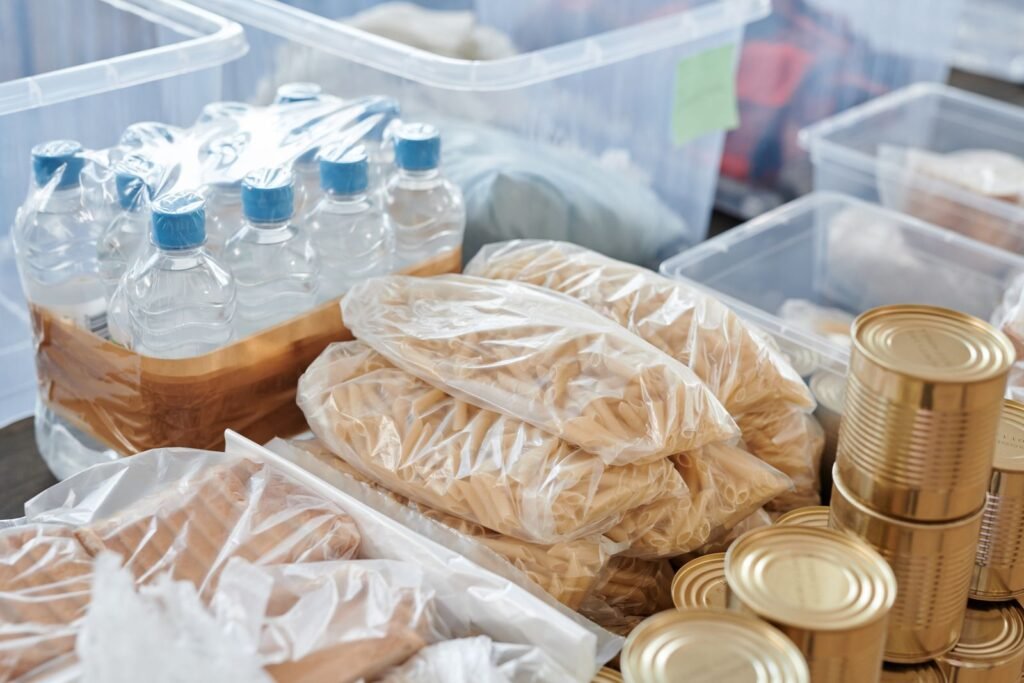
How much water to store
The CDC recommends storing at least 1 gallon of water per person per day for at least 3 days, and a 2-week supply if possible. Ready.gov uses the same 1-gallon figure for drinking and sanitation. The CDC also says to store more for pregnant women, people who are sick, pets, and anyone in a hot climate.
| Household | 3 days (minimum) | 2 weeks (recommended) |
|---|---|---|
| 1 person | 3 gallons | 14 gallons |
| 2 people | 6 gallons | 28 gallons |
| 4 people | 12 gallons | 56 gallons |
| 6 people | 18 gallons | 84 gallons |
A 2-week supply for a family of four is just over one 55-gallon drum. That’s a useful mental picture when you’re deciding on containers.
Water is only part of the plan. Our guide to how much food to stockpile per person uses the same per-person, per-day math for food.
The best containers for long term water storage
The CDC says unopened, commercially bottled water is the safest and most reliable emergency water source. If you’re filling your own, the container matters as much as the water.
What to use
- Food-grade plastic made for water. The CDC recommends FDA-approved food-grade containers. Most water jugs, stackable bricks and blue barrels are made from food-grade HDPE, marked with a #2 recycling code. If you’re not sure a container is food-grade, the CDC says to ask the manufacturer.
- 55-gallon drums. The most water per square foot. Plan for the weight, and buy a drum pump or siphon so you can actually get water out.
- Stackable water bricks. Smaller, rectangular containers in the 3 to 5 gallon range that stack in closets and under beds. Easy to carry and rotate.
- Clean food or drink containers. Mississippi State University Extension says store-bought containers that held food or drink are acceptable, with the milk jug exception below.
What to avoid
- Milk jugs. Mississippi State Extension advises against them because the hollow handle is very hard to clean and sanitize. They’re also thin and not built to last.
- Anything that held chemicals. The CDC says never use containers that held toxic substances like bleach or pesticides. Empty bleach jugs are not food-grade.
- Glass. If you can’t get food-grade containers, the CDC says choose something durable and unbreakable, not glass, with a tight-closing top.
- Non-food plastics. Utah State University Extension warns that plastic not made for food can leach chemicals, and that very lightweight plastic can split during storage.
Our guide to the best water storage containers compares drums, bricks and jugs by size, durability and how easy they are to pour from.
How to store water long term, step by step
This is the CDC’s container method, plus the EPA’s bleach table for treating the water itself.
Step 1: Clean and sanitize the container
- Wash the container with soap and rinse it completely with water.
- Mix 1 teaspoon of unscented liquid household chlorine bleach into 1 quart (4 cups) of water. The CDC says the bleach label should show 5% to 9% sodium hypochlorite.
- Pour the solution into the container, cover it tightly and shake so it touches every inside surface.
- Wait at least 30 seconds, then pour it out.
- Let the empty container air-dry.
Step 2: Fill it with safe water
Fill from a safe tap. Utah State Extension notes that tap and well water aren’t sterile and a few microbes can multiply during long storage, so it recommends treating water you plan to store for a long time. A small dose of bleach does that, and Utah State says it breaks down into oxygen and table salt over time.
Use the EPA’s emergency disinfection amounts. Use only regular, unscented bleach, with no added cleaners or scents.
| Amount of water | 6% bleach | 8.25% bleach |
|---|---|---|
| 1 quart or liter | 2 drops | 2 drops |
| 1 gallon | 8 drops | 6 drops |
| 2 gallons | 16 drops (1/4 tsp) | 12 drops (1/8 tsp) |
| 4 gallons | 1/3 tsp | 1/4 tsp |
| 8 gallons | 2/3 tsp | 1/2 tsp |
Stir, then let it stand 30 minutes. It should have a slight chlorine smell. If not, the EPA says to repeat the dose and wait another 15 minutes. If your water comes from a well, always treat it before storing.
Bleach weakens with age. Utah State Extension says it can lose up to half its strength after 6 months, so use a fresh bottle.
Step 3: Seal, label and store
Close the container with a tight lid, and avoid touching the inside of the cap. The CDC says to label it “drinking water” with the date you stored it. That date is how you’ll know when to rotate.
Where to store water
The CDC’s rule is simple: a cool place, between 50°F and 70°F, out of direct sunlight, and away from toxic substances like gasoline and pesticides. Utah State Extension explains why that last part matters. Plastic is permeable to certain vapors, so water stored next to gas cans or pesticides can pick up their taste and fumes.
- Good spots: a basement, an interior closet, under beds, or a pantry floor.
- Tricky spots: garages and sheds. They often run hot in summer, and they’re where people keep fuel, paint and lawn chemicals.
- Freezer space: Utah State Extension suggests freezing some water if you have room, leaving 2 to 3 inches of headspace for expansion. It keeps food cold longer if the power goes out.
- Spread it out. Keep a few gallons in more than one part of the house in case one area becomes hard to reach.
Should you store water on concrete?
This one gets debated online. The CDC and Ready.gov don’t mention concrete at all, and I couldn’t find official guidance saying concrete itself harms a sealed food-grade container. The real concerns are more practical: garage floors often have fuel, oil and chemical spills that plastic can absorb odors from, and concrete can be damp or cold. Utah State Extension recommends storing water off the ground. A wood pallet or a couple of boards under your barrels is cheap and solves all of it.
How often to rotate stored water
Rotation is the part of how to store water long term that most people skip. Ready.gov and the CDC both say to replace water that wasn’t commercially bottled every 6 months. For store-bought water, the CDC says to follow the expiration date. Utah State Extension notes that properly treated and stored water can last much longer, but recommends checking it every 6 to 12 months for loose lids, cracks and cloudiness.
An easy habit: rotate your water when you change your clocks in spring and fall. Use the old water for plants, cleaning or flushing, then sanitize, refill, treat and relabel.
Long term options: water preserver concentrates
If rotating every 6 months isn’t realistic, water preserver concentrates are one option people use for drums and larger containers. One brand, Water Preserver, says one bottle treats 55 gallons and guarantees the water for five years. That’s a manufacturer’s claim, not a government standard, so follow the label exactly, start with sanitized food-grade containers, and still check your water every year.
What to do if stored water looks or smells off
Stored water that tastes flat is normal. It has lost some dissolved air. Water that looks cloudy, has floating particles, smells bad, or shows green growth is a different story.
- Flat taste: the CDC and EPA suggest pouring it back and forth between clean containers and letting it stand for a few hours, or adding a pinch of salt per quart.
- Strong chlorine taste: the EPA says to pour it between clean containers and let it stand a few hours before drinking.
- Cloudy, slimy, green or bad-smelling: dump it. Clean and sanitize the container, then refill and treat. Not worth the risk when tap water is still running.
- Cracked or bulging container: replace it.
When you pour or scoop, the CDC says to use a clean scoop or pitcher each time, and never scoop with your hands or touch the inside of the container.
Treating stored water before you drink it
If your water was treated, sealed and stored properly, you can drink it as is. If you have any doubt, or it’s past its rotation date, treat it again. It takes a few minutes.
- Boil: the CDC says bring clear water to a rolling boil for 1 minute, or 3 minutes above 6,500 feet. Let it cool and store it in clean, covered containers.
- Bleach: use the EPA amounts above, and double the dose if the water is cloudy, colored or very cold. Filter cloudy water through a clean cloth or coffee filter first.
- Filter: the CDC says a filter needs a pore size of 1 micron or smaller for parasites and 0.3 micron or smaller for bacteria. Most portable filters don’t remove viruses, so the CDC recommends adding a chemical disinfectant after filtering.
At home, I keep the same Sawyer filter and Katadyn BeFree I carry on the trail as a backup. Our survival water filters guide covers gravity filters and pump filters sized for a family, and our guide on how to purify water goes deeper on boiling, bleach and tablets.
Common water storage mistakes
- Storing too little. Three days goes fast. Aim for two weeks.
- Using scented or color-safe bleach. The EPA says to use only regular, unscented bleach with no added cleaners.
- Never labeling or dating containers. Then you have no idea when to rotate.
- Filling a 55-gallon drum where it can’t stay. Fill it in place.
- Forgetting a way to get the water out. Drums need a pump or siphon.
- Rationing too early. Ready.gov says never ration drinking water unless authorities tell you to. Drink what you need today and look for more tomorrow.
That’s how to store water long term without overthinking it: enough for two weeks, in clean food-grade containers, treated, labeled, kept cool and dark, and rotated on a schedule. Once your water is handled, our emergency preparedness kit list covers the rest of your home kit.
Water storage FAQ
How long can you store tap water?
Ready.gov and the CDC say to replace self-filled water every 6 months. Properly treated water in sealed food-grade containers can last longer, but check it at least every 6 to 12 months.
How much bleach do I add to store water?
The EPA says 8 drops of regular 6% unscented bleach per gallon, or 6 drops of 8.25% bleach. Stir and wait 30 minutes. It should smell slightly of chlorine.
Can I store water in milk jugs?
It’s not recommended. Mississippi State Extension says the hollow handle is very hard to clean and sanitize. Use food-grade water containers or clean soda bottles instead.
Does bottled water expire?
The CDC says to follow the expiration date on commercially bottled water and keep it sealed in a cool, dark place.
Can I store water in the garage?
It’s possible, but not ideal. The CDC says keep stored water between 50 and 70°F and away from gasoline and pesticides. Garages often get hot and hold chemicals, and plastic can absorb their vapors.
How much water should I store for a family of four?
At least 12 gallons for 3 days, and about 56 gallons for 2 weeks, based on the CDC’s 1 gallon per person per day.
Sources
- CDC: How to Create an Emergency Water Supply
- CDC: How to Make Water Safe in an Emergency
- Ready.gov: Water
- EPA: Emergency Disinfection of Drinking Water
- Utah State University Extension: Water Storage and Emergency Use
- Mississippi State University Extension: Disaster Relief, Drinking Water in an Emergency
- Water Preserver (manufacturer)